Showing posts with label Shakespeare. Show all posts

Monday, July 20, 2015

Clever is as Silly Does....

In a fit of randomness, I decided today that I need to review a silly, clever book I just read, called Y is for Yorick: A Slightly Irreverent Shakespearean ABC Book for Grown-Ups. It's written by Jennifer Adams, the author behind the BabyLit board books, which are charming, uber-basic illustrated editions of classics such as Pride and Prejudice (a counting primer), Anna Karenina (a fashion primer), and Don Quixote (a Spanish language primer), among others. But while those books are actually suitable for babies and toddlers, Y is for Yorick really is, as the subtitle declares, for grown-ups. It's not "adult" per se, but the humor is the kind that grown-ups who like Shakespeare will appreciate.

For instance, we learn that "P is for Polonius," who was a "long-winded blowhard who was always giving unwanted advice. Eventually Hamlet killed him." Then, because many of the letters get bonus entries, we learn that "P is also for Prospero," who "was a bit of a control freak who liked the special effects. But who knows what any of us would do with unlimited time on a deserted island and a book of magical spells?" As often happens with alphabet books, whether for children or adults, the author has to reach a little for X and Z, but I think she does a pretty good job (and no, I'm not going to give spoilers on those!)

Aside from the text, the illustrations in this book, by Hugh D'Andrade, are both humorous and charming. They're all done in the same silhouette style shown on the cover: black (with the occasional spot of white) against a colored background, with faint pencil marks still showing. One of my favorites is the one above, showing Benedick pulling Beatrice's hair. I do find it a little odd that the illustrator's name doesn't appear on the book's cover, nor is there an "about the artist" blurb to go along with the author's bio on the back dustjacket flap. The illustrations, as well as the book's overall design (by Ron Stucki) really make this little volume, and I think the artist should be given more obvious credit (although I was pleased to see the author thank him in her acknowledgments).

And reading this fun bit of fluff reminded me of another book I stumbled across a few years ago, likely on a bargain table somewhere: The Not-So-Very-Nice Goings On at Victoria Lodge by Philip Ardagh, which carefully notes that the book is "without illustrations by the author." That's because the entire conceit of the book is that the author has written a silly little story around illustrations from issues of The Girls' Own Paper that appeared in the 1890s.

So how does that work? Well, you know those decorated/illustrated drop cap letters that used to start off chapters or sections in publications of old? Early in the story we see a picture of a lovely begowned lady standing by the letter "M"; the "narrator," Thelma, helpfully explains that her "tragic tale began when my eldest sister Edith was tending to the letter M in the shrubbery. We had a number of letters in our garden and it was her duty to feed and water the consonants from J to T."

How funny is that? And the plot (and shrubbery!) thickens when sinister attempts are made on Thelma's family's lives, such as when her younger sister is playing the piano when her music teacher "was shot through the window by a markswoman in a hot-air balloon," a moment that's illustrated with a drawing of a woman dramatically holding her hand to her forehead while leaning to look out a window. It's hard to convey how well this little set-up works just by describing examples, but it really does work, and I laughed out loud a couple of times.

I love clever stuff like this. Words are fun!

Read more!

Sunday, September 14, 2014

A Midsummer Night's Week

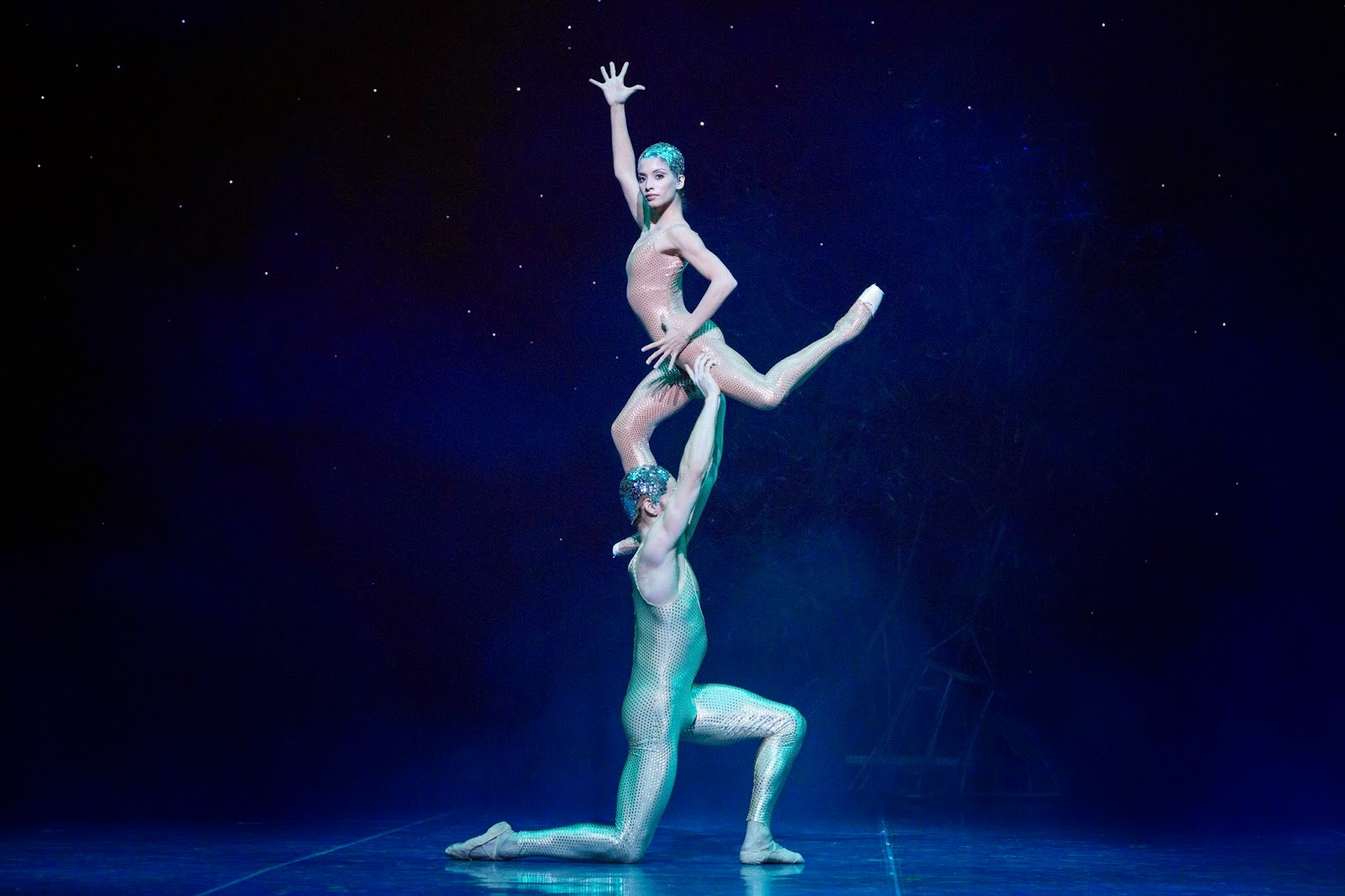
This week I immersed myself in William Shakespeare's A Midsummer Night's Dream, starting with the Houston Ballet performance on Saturday, September 6. It was an amazing ballet, about which I'll write much more below. It was so wonderful, in fact, that I immediately wanted to see it again (and not just because I'd had a coughing spell that made me miss fifteen minutes of the first act -- that was just a convenient excuse to go again!). So I went to see it again on Friday, September 12, choosing that night because I wanted to see the same cast. In between the two performances, I also watched the 1999 movie version of this work (starring, among others, Christian Bale, Rupert Everett, Calista Flockhart, Kevin Kline, Michelle Pfeiffer, and Stanley Tucci). I also listened to the story contained in the audiobook Shakespeare for Children by Charles and Mary Lamb.

And I have to say, knowing the story as well as I did by the time I saw the second performance really made a difference for me. By the time the two pairs of lovers get to the woods, there is no mistaking what is going on, but during the opening scenes of the ballet, it can be difficult to understand who loves whom, who is indifferent to whom, and who is outright annoyed by whom. This is through no fault of the dancers or choreography, but simply because it's not possible to watch all of them at once, especially when different things are happening on opposite ends of the stage. When I saw it the second time, I caught many things I'd missed the first time around, in large part because I had a better idea what to look for.

In my mind, the ballet was beautifully cast. I was thrilled to see all three female prinicpals in the leading roles, and thought they each had the right one. Melody Mennite is particularly good at comedic roles (although also a beautiful, romantic dancer), and so made a wonderful Helena. Sara Webb was the lovely Hermia, and Karina Gonzalez transitioned perfectly between Hippolyta and the otherworldly (almost alien) Titania. The ballet underplays Hippolyta's role as Queen of the Amazons, making Hippolyta instead a girlish and reluctant bride-to-be without the overtones of conquest, but considering how much the ballet has to convey in such a short time, I thought this was a wise choice.

Not enough can be said about Connor Walsh as Puck. I sat in the Loge Boxes in the first performance and the balcony the second; I could have kicked myself for forgetting to bring opera glasses both times, but I could see Connor Walsh's comic facial expressions even from the balcony. My husband and I always hope to see him in the lead the nights we attend, because we think he is easily the best male actor in the company, and that doesn't come at the expense of athletic and dancing ability. He is incredibly powerful.

In the other leads roles, Aaron Robison played Theseus and Oberon. Like Karina Gonzalez, he made the transition well, looking alien and freakishly angular as Oberon, but romantic and dreamy by the time he reappears as Theseus in Act II. Linnar Looris conveyed Demetrius' arrogance and self-importance well, and was a great counter to Helena's ludicrous attempts to hang on to him. Ian Casady was appealing as Lysander. James Gotesky, one of my favorite dancers in the company, played Bottom, and Christopher Coomer also stood out as Flute, who in turn must play the female role of Thisbe in the play presented by the Mechanicals at the wedding.

The comedic elements of this ballet are terrific. Instead of having to listen to Helena in the play as she literally tells Demetrius that she will be his spaniel, and he can kick and beat her without changing her love for him, we can watch the more lighthearted interpretation in which Helena hangs on Demetrius in a pathetic manner that yet manages to be more funny than sad. By the time Demetrius and Lysander are both fighting for Helena's affections, and poor Hermia is trying to figure out what's going on, it's hysterical. And when Puck finally has to unravel the disaster he's created, his clumsy attempts to physically put the right couples together are laugh-out-loud funny. I don't think this ballet misses a single opportunity for physical comedy.

There were only a few minor things about the production I would have changed. I loved the fairy costumes, but would have liked to see the primary fairy roles (Cobweb, Peaseblossom, Mustardseed, and Moth) just slightly distinguished in their dress. I'm not sure how they could have done this precisely, because the usual trick of a sash or a ribbon or a slightly different color would not quite have worked with their flesh-colored, slightly metallic skin-tight leotards. There was one point when I could tell that two of these four characters were dancing, but only because I recognized the dancer, Katherine Precourt, and knew her to be in that particular role. (It says something in itself that I could recognize her without opera glasses, from that far away, while in identical costumes with her hair completely covered, but I believe I would recognize her shape and her dancing even if she had a paper bag over her head. She's intense and powerful.)

Similarly, I would have liked to see a tiny bit more to Puck's costume. I wanted something just slightly twiggy or leafy. Puck is a lot different than the fairies, and I wanted that represented a bit more.

I had one moment of disconnect when Demetrius and Helena have their spotlight dance at the wedding, in this case because of the music. I could not tell from the program what piece of music they danced to, and it's possible it was still the main composer (Mendelssohn), but out of nowhere the music for this couple because almost Asian or eastern, and slightly exotic, and somehow completely out of keeping with the comedy of Helena and with the pageantry of the rest of the scene. I have a vague idea that this music was supposed to represent Demetrius' culture or something -- in ballet, you get a lot of prospective grooms, or fathers presenting their daughters as prospective brides, with exhibition dances that clearly represent their particular ethnicity or culture. But I didn't get any hint early in the ballet that this was meant to be the case with either Demetrius or Helena.

I wish I could have also seen the alternate cast, in particular Jessica Collado as Hermia and Emily Bowen as Helena. I'd also love to see how Aaron Robison danced Bottom the Weaver, quite a different role than Thesius/Oberon.

Later this season, Houston Ballet will perform The Taming of the Shrew and Romeo and Juliet. I'll be brushing up on both works in other media before seeing the ballet performances. The more you put in to Shakespeare, and to ballet, the more you get out of it.


[Top and bottom photos are Aaron Robison as Oberson and Katrina Gonzalez as Titania; middle photo is Linnar Looris as Demetrius and Melody Mennite as Helena. Photos are property of the Houston Ballet].
Read more!

Saturday, September 6, 2014

A Tale of Two Art Forms: Houston Grand Opera and the Houston Ballet


Yesterday my husband and I had a great experience, or two great experiences, really, in an amazing juxtaposition. Over lunchtime, we attended a workshop by HGOco, which is “Houston Grand Opera’s unique initiative that connects HGO to the community through meaningful collaboration." A lot of what HGOco does consists of workshops, opera camps, student-only performances, etc., but they also commission works particularly relevant to the local community. Along those lines, in the fall of 2015, HGO will premiere O Columbia, a chamber opera telling the story of the exploring spirit in general and the Columbia shuttle tragedy in particular.

At yesterday’s workshop, we listened to a libretto reading given by professional actors for the material as it exists to date. The entire creative team was in attendance, including librettist Royce Vavrek, composer Gregory Spears, HGOco Music Advisor David Hanlon, and director Kevin Newbury. The purpose of the workshop was for the creative team to get feedback from several opera enthusiasts as well as current and former NASA employees, including at least one astronaut. This allows them to assess whether the piece is moving in the right direction before the work goes further, particularly the musical composition.

For us, it offered an extremely rare opportunity to see the early stages of the creative process in action. I didn't know that the libretto comes before the music, and now that I know, I still can’t imagine the complexities of having to write words that will be sung when you don’t yet know the melody (although of course they have been collaborating throughout the process, so they’re on the same page in that regard), or the difficulty of fitting the music around words while also carrying certain melodic themes throughout the entire work. We've had season tickets to the opera for a few years now, and I know that I will look at productions differently after having seen some of what goes into them.

Without going into further details, I have to say that if you live anywhere in Texas, when the time comes you should make every effort to get to Houston to see O Columbia. (Although you don't have to live in Texas -- there are lots of flights to Houston every day!) It’s going to be an amazing opera, one that’s incredibly personal to anyone even remotely affiliated with NASA or simply interested in human spaceflight. It will be even more personal to those of us who live in Houston, but it’s not limited to that. So remember: Fall 2015. This is going to be really special, and shouldn’t be missed.

By complete coincidence, yesterday evening we also attended a talk presented by the Houston Ballet. Every season, the company puts on three full-length ballets and three mixed repertoire performances. This year, all three full-lengths will be Shakespeare (how fun is that?!), so last night’s Ballet Talk was about interpreting Shakespeare through dance. I hadn’t really thought about it before, but it’s a fascinating topic, because Shakespeare is all about the language, none of which is available in dance. Houston Ballet will be performing A Midsummer Night’s Dream, Romeo and Juliet, and The Taming of the Shrew over the 2014-15 season, and now I can't wait to compare them to the plays. (Tangent: a fun coincidence is that the first opera I ever saw was HGO’s performance of Benjamin Britten’s A Midsummer Night’s Dream. It’s really interesting to see the same story as both opera and ballet; I believe the only other story I’ve seen in both forms is Madame Butterfly.)

For this Ballet Talk, the panel of experts consisted of Artistic Director (and choreographer) Stanton Welch, Managing Director Emeritus and ballet historian Cecil C. Conner, Jr., and University of Houston-Clear Lake literature professor Dr. Elizabeth Klett. The talk began with some interesting literary context from Dr. Klett. For instance, who knew that the story was not original to Shakespeare, but came instead from what Dr. Klett said was a "frankly terrible" 1562 poem by Arthur Brooke titled "The Tragicall History of Romeus and Juliet"? Dr. Klett gave us lots of other interesting tidbits, and was followed by Mr. Conner's overview of various Shakespearean ballets over the years, accompanied by some lovely photographs of famous performances.

My favorite part of the talk, though, was when Stanton Welch spoke about the new Romeo and Juliet he’s creating that will premiere in the spring. He said that while you might expect the artistic process for a new production to begin with the choreography, it’s actually the opposite: you start with the sets (built with models down to opening doors and cloth backdrops) and the costumes and don’t get down to the characters and the choreography until much later. This production's scenery and costumes have been designed by Roberta Guidi di Bagno (go here for a great blog post by Laura Lynch, Houston Ballet Wardrobe Manager, on working with the designer and shopping for fabrics in Rome).

Another thing Mr. Welch discussed was his intention to reestablish many of the play’s minor characters that have been eliminated from most dance productions. Another part of the process is settling on intentions and motivation; he said that in watching several versions of the play, he’s noticed that Mercutio’s famous speech has been played as slightly mad, as humorous, as angry…. Which of those will ultimately fit the version he wants to tell, and how to portray that in dance?

As with the opera workshop, I felt we were getting a look at the creative process in action. Especially when re-creating one of the most performed stories in recent history, how do you keep all that in mind and manage to make it all come together in the end, into a work that has its own personality?

And to think all this time I've thought that simply writing a short story was difficult. It is difficult, to be fair, but I have to admit that I'm amazed at what goes in to these other, extremely complex forms of storytelling. I’m glad there are such talented people out there who are so devoted to these two art forms.


[Costume design sketch by Roberta Guidi di Bagno.]
Read more!