Showing posts with label ballet. Show all posts

Friday, September 16, 2016

A Tale of Two Art Forms, Part II: Houston Ballet and Houston Grand Opera

[Cover of Madama Butterfly, a quadrilingual picture book by Monica E. Lapenta (author) and Stefania Pravato (illustrator)]. Paramica/LaMa House Publishing, 2008.]


A few nights ago I was fortunate enough to attend Houston Ballet's Dance Talk titled "A Closer Look at Cio-Cio San", who is also known as "Madame Butterfly." This talk was a lead-up to Houston Ballet's upcoming production of Madame Butterfly, a two-act ballet created by the company's Artistic Director, Stanton Welch, back in 1995 for The Australian Ballet. This, in turn, was based on Puccini's opera Madama Butterfly. (The "a" is not a typo; the opera really is titled Madama rather than Madame.)

I always enjoy Houston Ballet's "Dance Talks," but this one was particularly thrilling for me because we not only got to hear about the character of Cio-Cio San from Yuriko Kajiya, one of Houston Ballet's principal dancers who will be dancing as Cio-Cio San in the upcoming production, the panel also included Vicki Attard, who originated the role in Welch's premiere of this ballet, and Ana María Martínez, whom we have seen sing the role in Houston Grand Opera's production of Puccini's opera not once, but twice.

The discussion was ably led by Dr. Howard Pollack from UH Moore's School of Music. Dr. Pollack first gave some background on the ballet, which is based on the opera, which is based on David Belasco's one-act play titled Madame Butterfly: A Tragedy of Japan. And that was based on the 1898 short story titled "Madame Butterfly" by John Luther Long, which was partially based on stories told to Long by his sister and partially on Pierre Loti's 1887 French novel Madame Chrysanthème.

Got all that? There will be a quiz.

The panel discussion lasted about an hour, but it seemed to fly by much more quickly than that. The artists discussed the fact that modern audiences may view Cio-Cio San as a victim, but within the context of her story, her strength is illuminated when she sacrifices herself for her child. They also spoke about the challenge of performing opposite different singers/dancers as Pinkerton, and performing with a small child or, as Ms. Martinez did at the Metropolitan Opera, with a puppet (and three puppeteers!) representing the child.

My favorite moment of insight came when Ms. Kajiya charmingly stated that the dancer must first "get the steps into your body" before developing the emotional layers that go with the role; the dancers can't act realistically if they are thinking about the steps or the count, so those things must become second nature. I also enjoyed hearing about how she had to study up on Japanese attire, gestures, and movement, since the traditional attire has not been worn widely in Japan during her lifetime.

I was also impressed with how articulately Ms. Attard and Ms. Martinez described the process of bringing a character to life. People sometimes mistakenly assume that ballet dancers are unthinking dolls, but in actuality, the best dancers take a deep and intellectual approach to their characters. Similarly, opera singers literally must learn to convey emotion in many different languages, since most operas follow the language of the composer. If I recall correctly, we've heard Ms. Martinez sing beautifully in French (Carmen), Italian (Madama Butterfly), and Czech (Rusalka). It's not enough to learn the words by rote; the singers have to understand and convey what they're singing at all times.

All three of these strong, passionate, talented women were kind enough to sign my copy of the quadrilingual picture book shown at the top of this post, a book that is now a very treasured possession for me.

Houston Ballet's production of Madame Butterfly runs from September 22 to October 2, 2016. Tickets are available here. In addition, Ms. Martinez is in town to perform as Marguerite in Houston Grand Opera's production of Gounod's Faust, which runs from October 28 to November 11, 2016 (tickets here).

[Click here for the post "A Tale of Two Art Forms, Part I"]


Read more!

Sunday, December 13, 2015

Pop-Up Microfiction: Endless Suite

Tired of The Nutcracker? This little piece of pop-up microfiction says that you might not be the only one. A slightly different version of this story was originally published by Apex in December 2013, as the third place winner in their Christmas horror microfiction contest.


I couldn't resist mentioning the Houston Ballet....

Creative Commons License
Endless Suite by Amy Sisson is licensed under a Creative Commons Attribution-NonCommercial-ShareAlike 4.0 International License.


Read more!

Saturday, December 5, 2015

Houston Ballet's Jubilee of Dance

Houston Ballet principal dancers Karina Gonzalez and Connor Walsh.

Most people, when they think "ballet" and "holidays," think of The Nutcracker, but for me, the Christmas season begins with Houston Ballet's Jubilee of Dance, a yearly one-night production that takes place on the first Friday in December. For one evening, the dancers and audience get a break from Sugar Plum Fairies, and instead perform highlights from past seasons as well as the upcoming season. Many years, there is a short video retrospective honoring a retiring dancer or a long-term employee. And although the company's principal dancers do appear throughout, I tend to think of this performance as something of an "audition" for some of the non-principal dancers, as they are often featured in significant and/or difficult roles.

The performance opened with Sleeping Beauty's "Rose Adagio", which Wikipedia describes as "one of the most notoriously difficult sequences in all of ballet." This piece featured Katharine Precourt, who along with Karina Gonzalez is one of my two favorite female dancers in the company. I can see why the piece is considered so difficult; the princess, Aurora, accepts a rose from each of her four suitors, and balances in one precarious position for an impossible length of time, while each suitor comes forward in turn to take her hand. I thought Ms. Precourt danced it beautifully. I have to admit that I wasn't crazy about the costumes, though; Aurora's tutu was a garish pink that looked even more out of place due to the lack of stage sets.

Throughout the first "act," we saw two other pieces from The Sleeping Beauty: the Act III pas de deux, featuring Sara Webb and Jared Matthews, and the Act III finale. In February/March 2016, the company will be performing the full production to honor the 80th birthday of Artistic Director Emeritus Ben Stevenson.

Other pieces were interspersed throughout the first act, including pas de deux from Giselle (which will also be staged in 2016) and Manon, the latter of which has some of my favorite ballet music, by Massenet. I was also happy to see the "Cancer" segment from the Zodiac piece that we saw last June. (Review here.)


The second "act" consisted of a single piece: the Capulet Ball and the balcony scene from last season's new production of Romeo and Juliet (preview post here). This time they did use the full sets, and it was as scrumptious as I remembered, with principals Connor Walsh and Karina Gonzalez reprising the lead roles.

My favorite part of the evening was the third act, Brigade, choreographed by Stanton Welch and set to music by Benjamin Britten. I'm not particularly a fan of Britten's operas, but I do like his ballet music. This piece had several movements, each featuring a different dancer or small group in classic, pale blue costumes dancing with classic technique. There was also a big finale featuring many artists. The only set dressing consisted of several crystal chandeliers, but it was enough to give the impression of a grand ballroom. I felt that this act had more energy than the others, and for me the standout performance was that of Hayden Stark during the "Waltz" movement.

In addition to The Nutcracker, Houston Ballet has four other major productions coming in the first half of 2016: the aforementioned Sleeping Beauty and Giselle, and two mixed rep performances, one of which will include pieces from West Side Story. If you live in Houston and you haven't seen what this company can do, I highly recommend going to at least one of these shows. Personally, I prefer the variety and energy of the mixed-rep programs, but you really can't go wrong with any of their performances.

Read more!

Saturday, October 3, 2015

Houston Ballet Fall Repertory


Last night we saw Houston Ballet's Fall Repertory program, and if you'll forgive me for gushing, I believe that may be the most perfect evening of dance I've ever seen. I've said for a while that I actually prefer the mixed rep nights more than the full-length ballets, but normally there's at least one of the pieces that I didn't quite like as much as the others. Not so this time; they were all incredible.

The performance began with Stanton Welch's "Tapestry", which was set to Violin Concerto No. 5 by Mozart. We saw this piece when it premiered in 2012, and I was happy to see it again. There are three main movements (although I'm not sure I'm technically using the term correctly here), and perhaps it has to do with my food-centric short story reading in September, but I thought of each movement as a food course. This probably won't make much sense to anyone but me, but the first part made me think of blood orange creamsicle mimosas, the second of sweet and tart green apples, and the third of butternut squash and russet apples. Hmmm, remembering how I thought of last season's Romeo & Juliet costumes as raspberry sherbet, I'm beginning to think I have some weird music-color-food synesthesia....

But back to "Tapestry" itself ... I've often thought that Stanton Welch hears music and sees its movement, which he then teaches to the dancers. Not one possible movement for those notes, but the specific movement that was intended when the melody was created. There was only one moment when it felt a tiny bit too literal for me, which was when female dancers timed jumps into the males' arms and froze in place. It seemed almost jarring, and took me out of the moment. On the other hand, I don't know what another solution would be, since the music does stop that suddenly.

In any case, I felt that the rest of the piece was pretty much perfect. There was one part in particular, when principles Connor Walsh and Ian Cassidy lightly tossed Karina Gonzalez between them and it was so light and airy she seemed like a handkerchief fluttering from one to the other. I mean, it looked effortless. There was also a part that beautifully showcased three exciting male dancers: Aaron Robison, Oliver Halkowich, and Harper Watters. Last but not least, violin soloist Denise Tarrant was amazing, and received a tremendous round of applause.


The second piece was Christopher Bruce's "Ghost Dances", which premiered in Bristol, England, in 1981 and in Houston in 1988. The program describes the opening scene, in which "three skeletal figures with matted hair await the next consignment of the Dead." The piece begins in silence (something I struggle with, because then I notice the audience's every last cough and shift in their seats) with these three figures on a sort of rocky shore. Then, a group of men and women arrive in various types of dress. I hadn't read the program description before seeing it, but it was easy enough to interpret that these people were dead. To me, they seemed to be puppets, or animated corpses trying to hang on to life, not knowing that it has already been taken from them.

This ballet also had a post-apocalyptic feel to me -- rather than seeing these people as just a handful who happened to have died recently, I felt as though the whole world had died. Very specifically, I got a kind of Avatar-meets-Mad-Max-zombies vibe, and I was also reminded of a very intense young adult book I read a few years ago, The Marbury Lens by Andrew Smith. It was about a boy who kept transitioning between the real world and a cannibalistic, post-apocalyptic version in which he finds the counterparts of many of his real-life friends. Of course, there's no relation between the ballet and this book, not even remotely, but I mention it because it shows that we all bring our own powerful associations to any art form that we experience. Just as no two people read the same book, no two people see the same ballet.

At the risk of gushing again, I also have to say that any time James Gotesky is on stage, I can't take my eyes off of him. I also loved the recorded Chilean folk music by Inti-Illimani, and will definitely seek out some of their work.


The third piece was a world premiere: "Reveal", choreographed by former Houston Ballet dancer Garrett Smith. This ballet had some of the most dramatic, effective lighting I've ever seen in a ballet. It was set to music by Phillip Glass, and primarily showcased a female dancer and her reverse-negative mirror image. In the program, the choreographer says "As dancers, you're always constantly training and trying and sculpting your body, constantly looking in that mirror all day to the point of obsessing with this love-hate relationship of ballet. In Reveal I wanted to try to let go of that and just embrace and accept what you have been given in life."

It's hard to describe this ballet more specifically than that, as it was fairly abstract, but it was absolutely haunting. I also loved its genderbending qualities, and thought that the music made it seem as though the stakes were life and death.

There are two more performances of this mixed rep production: tonight (Saturday October 3) and tomorrow afternoon (Sunday October 4).

[All photos property of Houston Ballet. Top: Connor Walsh, Karina Gonzalez, and Ian Casady in Tapestry. Middle: cast of Ghost Dances. Bottom: Karina Gonzalez in Reveal.]

Edited to add: A friend of mine named Cole Mikeska, who also sees all of Houston Ballet and Houston Grand Opera's performances, had something to say about "Ghost Dances" that I found intriguing. He said that he thought the "dances between the group marching in and out were flashbacks to their individual lives and what they remember. As a few fell out, that was the point that they realized they were dead." He also said about "Reveal" that he would describe it as "the ego becoming aware of the id via the mind of David Lynch."

This is what I mean every time I say I support the arts, and write fiction myself, because I want to be "part of the conversation." Every time we see a piece of art and talk to others about it, we get to see something new in it through their eyes as well.

My friend's blog, "The World According to Cole", is here. Check it out for interesting reviews, including "30-second movie reviews," and commentary on social issues.

Read more!

Wednesday, September 2, 2015

Houston Ballet Dance Talk - "Discover Manon"

Originally I intended to wait until after I'd actually seen Houston Ballet's Manon before I would write about the dance talk pertaining to this production, but the talk, which I attended last night, was so outstanding that it deserves mention all on its own.

By way of background, the Houston Ballet puts on several dance talks each season that are free and open to the public; these may feature the company's Artistic Director (Stanton Welch), ballet historians, dance and/or literary scholars, conductors, dance teachers, and, of course, dancers. The talks are held on weekday evenings, usually leading into a specific production, and are about an hour long. They take place at the Houston Ballet Center for Dance, which is the fairly new and quite gorgeous rehearsal space for the company, located on Preston Street in downtown Houston.

Last night's talk served as an introduction for the season's opening production of Manon, a three-act ballet created by choreographer Sir Kenneth MacMillan in 1974; it is set to music by Jules Massenet and based on the 1731 novel by Abbé Prévost titled L'Histoire du chevalier des Grieux et de Manon Lescaut. Rather than a lecture, the talk consisted of a panel discussion led by Elizabeth Klett, a professor of Literature at UH-Clear Lake whom we saw speak last year on interpretations of Shakespeare in ballet. For this talk, she was joined by Assistant Conductor Ned Battista and répétiteur (*) Bruce Sansom -- a terrific combination, because between them they could speak authoritatively on the literature, music, and movement of Manon.

Dr. Klett began with some background on the novel, which she points out has not one but two title characters: des Grieux and Manon. The multi-part work was considered quite racy at the time due to Manon's questionable morals. Dr. Klett also referenced a June 2006 New York Times article about three different dancers' interpretations of the character, who transforms from innocent girl to celebrated courtesan to impoverished prostitute over the course of the ballet.

Dr. Klett then invited Ned Battista to speak to the music, which was particularly fascinating. Although Jules Massenet (1842-1912) had composed an entire five-act opera for Manon, which was first performed in 1884, MacMillan decided he wanted to use different music -- but by the same composer -- for the ballet. As a result, every note of the ballet's composite score was written by Massenet, but not one note of it came from Massenet's opera. Instead, MacMillan hired musicians to comb through Massenet's catalog of work to find pieces of music to fit the ballet he envisioned, a difficult task considering that the pieces needed to sound organically cohesive.

Mr. Battista also noted that the ballet makes use of what some have derisively referred to as the "calling card" technique, in which each character has a distinctive motif, a la Wagner's Ring Cycle. (I hope it doesn't horrify any ballet or opera enthusiasts for me to say that my first experience of this technique came when I saw The Empire Strikes Back at age twelve; in addition to the more heavy-handed Darth Vader theme, I can also recall the gentler motifs for Princess Leia, Han Solo, and Yoda.)

This provided a segue for Dr. Klett to ask Mr. Sansom about similar motifs in the choreography, and he explained that Manon repeats, once in each act, the same sequence of steps yet with different interpretations depending upon her circumstances at the time (innocent girl, celebrated courtesan, and somewhat enfeebled prostitute). He also spoke about his own experiences dancing in this ballet, having performed many of its roles, including that of des Grieux.

The talk ended with questions from the audience; my favorite was when a woman asked Mr. Battista about working with dancers as opposed to singers. He answered that the conductor does have to watching the dancers closely, stating (more colorfully than this) that if the dancer is a little bit behind tempo, you have to pull up and not let them (or make them) crash. I loved the answer because it showed how strongly he felt that it's a give and take process, and they're all there to work with each other. Rigid adherence to having one's own way, he said, is not the way to make art.

Houston Ballet's Manon will run from September 10-20, 2015.

[* a person who teaches the steps and coaches the interpretation]

Read more!

Sunday, June 14, 2015

Houston Ballet - The Taming of the Shrew


(Connor Walsh and Melody Mennite as Petruchio and Katherina; image property of the Houston Ballet.)

What a lovely end to the ballet season! I didn't manage to "prep" as much as I would have liked for this production of The Taming of the Shrew -- I would have liked to watch one of the film versions or listened to the play ahead of time, and I missed the recent ballet talk in which some of the dancers spoke about their roles in this season's productions of Shakespearean ballets. Any one of those things would have enriched my experience of seeing this ballet again (I saw it in 2011 as well), but it was still fine in the end, because if ever there was a ballet where you can tell precisely what is going on at all times, this is it.

The Clif Notes version is that the pretty Bianca (Yuriko Kajiya in the June 13 performance that we saw) has many suitors, but cannot marry until her older sister, the feisty Katherina (Jessica Collado) gets married herself. And that seems unlikely, because Katherina is clearly ready to fight off every man she encounters. In desperation, Bianca's three most ardent suitors team up to bribe the oft-drunk Petruchio (Linnar Looris) to woo Katherina. Although it takes a while, Petruchio manages to wear Katherina down, and she becomes the model wife. And this, of course, allows Bianca to marry her favorite beau, Lucentio (Ian Casady).

OK, feminist it's not, and there really should be better ways to deal with your new bride than half-starving and half-freezing her to death. But the tone of the ballet is so light and funny that I couldn't waste time being offended, and the story was written a while back, after all. And in any case, I choose to interpret the ballet version in the Moonlighting episode kind of way; Katherina may have learned how better to deal with and (gasp!) care for people, but she will still be Katherina, and theirs will not be a she-who-obeys-mindlessly marriage.

In my mind, The Taming of the Shrew, believed to have been originally written between 1590 and 1592, has just the right amount of "story" for a full-length ballet; it's neither too simplistic nor too complicated. There's room for "exhibition" dances -- after all, all three of Bianca's suitors must woo her separately, and some of the funniest moments are when Gremio (Rhodes Elliott) and Hortensio (Chun Wai Chan) dance, one attempting to "sing" (represented by the piccolo) and the other playing a lute, which Katherina eventually smashes over his head. I'm also a sucker for wedding crowd scenes, which in this production are nicely set off by the costumes and the pretty sets (by Susan Benson) that often reminded me of rose damask.

Unsurprisingly, the dancing was wonderful. Jessica Collado seemed very much at home in this comedic lead role, while Yuriko Kajiya had the pretty girlishness one would expect from Bianca. Linnar Looris also nailed the body language during his "drunken" dancing.

There's not a lot more to say about this ballet; it's hardly deep, after all. But it was pretty and fun and full of clever choreography. There are several more performances of The Taming of the Shrew next weekend of (June 19-21). I highly recommend it.
Read more!

Saturday, June 6, 2015

Houston Ballet - Morris, Welch & Kylian

Last night, my husband and I saw the "Summer Mixed Rep" program at the Houston Ballet, consisting of two world premieres, Zodiac by Stanton Welch and The Letter V by Mark Morris, and a returning piece from choreographer Jirí Kylián titled Svadebka, which premiered in the Netherlands in 1982 and was performed by the Houston Ballet in 2007.

The first piece was Zodiac by Stanton Welch, a world premiere set to new music by Ross Edwards commissioned especially for this piece. I really hope that a recording of this music will eventually be available, because it was gorgeous and I would buy it in a heartbeat. It was sophisticated and dramatic, and it created a unique musical "signature" for each of the twelve signs, which couldn't have been easy. (The Houston Ballet En Pointe blog has a brief interview with Mr. Edwards here.)

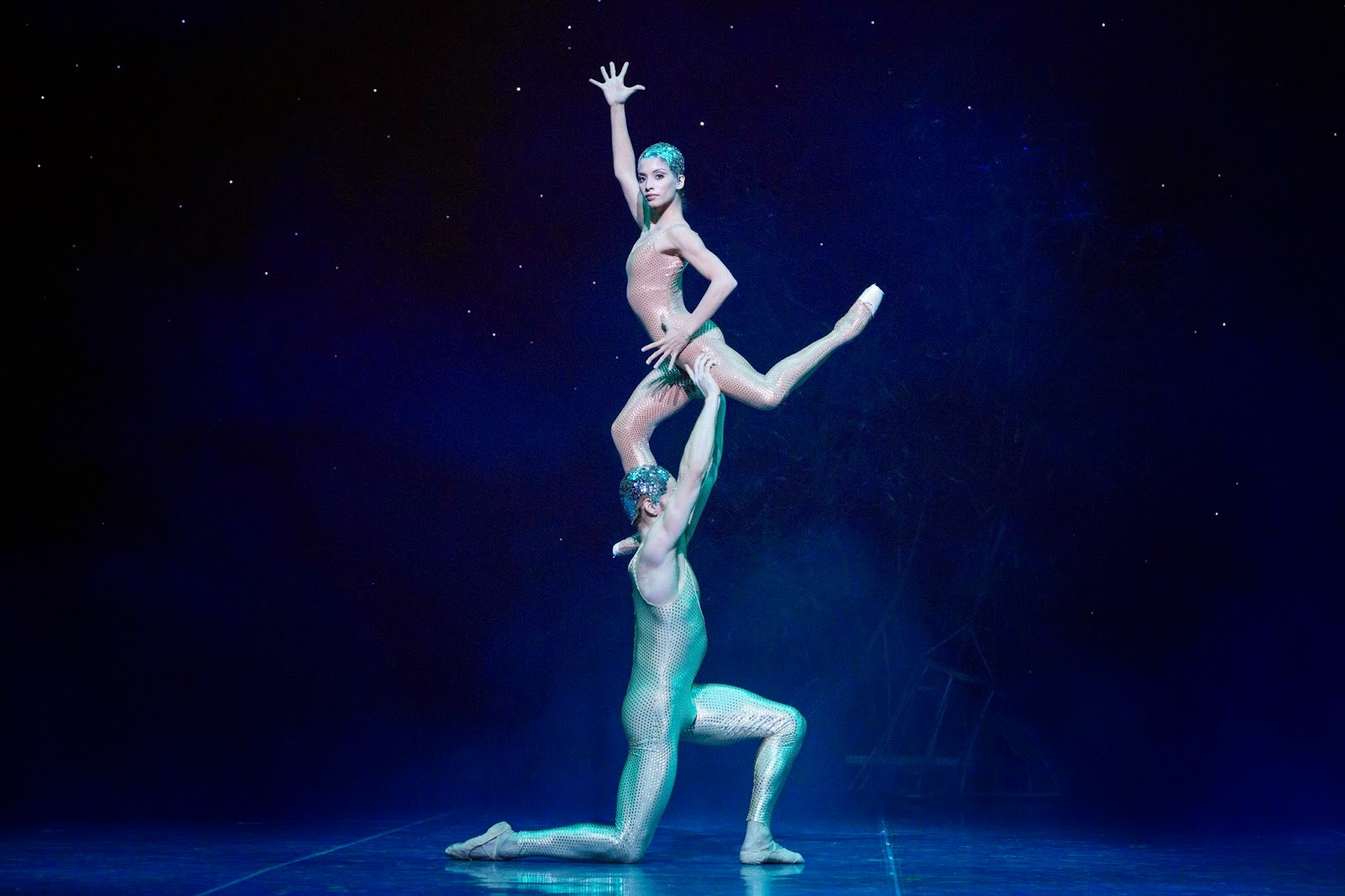
So, twelve movements, each representing one of the zodiac signs -- what an irresistible concept! And it was simply stunning. You would think that with twelve short movements, each lasting only 3-4 minutes, that they would all run together in a blur, but they really didn't. Several of the movements stood out in particular, but there wasn't a single one I didn't like. The piece started quietly, with the only sound coming from the slowly pounding feet of twelve helmeted ancient warriors against a backdrop of stars and a stylized eclipse. A woman came forward to remove one dancer's helmet, and the individual movements began with Aries. Each movement featured a male dancer with the astrological sign painted on his chest, and, except for Libra, differing numbers of additional male and female dancers, with several signs conveyed by a pas de deux. The piece ended in reverse, with the woman replacing the warrior's helmet, once again to the sound of stomping feet.

My favorite movements were Aries, in which first soloist Aaron Robison performed a series of breathtaking turns that went on for an impossible length of time; Gemini, which incorporated a certain amount of mischievousness in the twins' leaps and turns around each other; and Aquarius, in which the steps at times gave the impression of running waters. I loved Eduardo Sicangco's costumes, which like the music were unique for each sign. (Go here for another Houston Ballet blog post about the costume designer. This sketch, and the photograph at the top of this post, show the concept design and the finished costume for Taurus, danced by Madeline Skelly.) I should also mention the lighting design by Lisa J. Pinkham, something one doesn't always notice in a dance production. Again, it was unique for each sign, and very striking, especially the patterns on the floor that changed for each movement.

The second piece, Svadebka by choreographer Jirí Kylián, was wildly different from Zodiac, which is the beauty of mixed rep programs. I felt like I was seeing a Russian-wedding-slash-Amish-barnraising during which dancers from Fiddler on the Roof and West Side Story appeared on the scene. And I mean that in the best possible way! This piece was odd, with dramatic music by Igor Stravinsky including vocals by the Houston Chamber Choir, but it was rich and beautiful and I didn't want it to end. It's a wedding, but is it a happy occasion? Is it arranged? The bride (Jessica Collado) seems reluctant at times, and the mother (Katherine Precourt) seems to project a tragic inevitability, but is that because of the specific union, or because this community is in the depths of poverty or even war? I don't mind not knowing; regardless of specifics, I came away from this piece feeling the energy and earthiness of it.

Unfortunately, the Mark Morris piece, The Letter V, did not quite work for me. The music, Symphony No. 88 in G Major by Joseph Haydn, was gorgeous, but it was also sedate, and there just wasn't a lot of energy or intricate steps or even visual interest to keep the audience engaged. I also felt the costumes were distracting. When the first ballerina appeared in what looked to be a green and black striped leotard with a flowing cream-colored chiffon (I'm guessing) overlay, I thought that it was pretty. But when three other female dancers appeared in the same costume, the stripes began to overwhelm, and it was made worse when the male dancers joined them. That group was eventually joined by four more pairs wearing what looked like green and black checked gingham, which was also puzzling.

To be fair, the dancing in this piece was still lovely, and it probably suffered unfairly in comparison to the two previous pieces. I've seen other work by this choreographer, who is critically acclaimed and rightly so. This piece just didn't click for me; I couldn't feel inspired because I couldn't see it as inspired.

Overall, it was a wonderful evening, and every time I see a mixed rep program, I begin to suspect that I secretly prefer them to the full-length ballets. I think what I actually like the best is classical technique mixed into contemporary dance, and I certainly feel like I got that here. I'm going back to see it again at tomorrow's Sunday matinee; I can't wait to see what nuances I missed the first time around.

And just to prove how subjective this all is, I just found this review in the New York Times, which comes to the exact opposite conclusions that I do! The reviewer, Alastair Macauley, knows orders of magnitude more about ballet than I do, while all I can do is comment on what I do and don't like. For that reason, I don't read other reviews until after I've written my own, but I like to read them then because I can learn from them.


All images property of the Houston Ballet.
Read more!

Saturday, April 4, 2015

Dance Salad

The program for the Dance Salad festival, which is now in its twentieth year, describes it as a "variety of fresh dance ingredients by choreographers and dancers serving you a fusion of East and West contemporary and classical dance, tossed with modern and classical music, seasoned with the poetic sensitivity of beautiful choreography." This year, the companies performing over the span of the three-day festival were from New York, Texas, Australia, Norway, Belgium, the Netherlands, Germany, and Korea. The audience, too, is international; the couple sitting next to us spoke German, and I heard both Russian and French from the crowd at intermission.

Dance Salad runs Thursday, Friday, and Saturday every year, and if you go more than once, you'll see some overlap but some new things as well, as several of the companies come with more than one piece prepared. The first piece we saw was "Trompe L'Oeil", choreographed by Jiří Kylián and performed by Introdans, the company from the Netherlands. It featured two female and two male dancers, starting out in chairs as a sort of mime version of wind-up dolls, and moved through several sequences, including one in which a couple's pas de deux is interrupted when he gets a cell phone call. Much of the choreography was clever, but I had a bit of trouble with this piece because it seemed random and unconnected with itself. There were some vocal elements mixed in and we did get another hint at music box dancers later in the piece, but in the end I couldn't find anything to fasten on to, and the cell phone routine in particular didn't seem like it belonged in the piece. My husband and two friends disagreed with me, though, so clearly this is a matter of personal preferences.

We certainly all agreed on the next piece, though, which was titled "Short Dialogues". It was choreographed by Nils Christe and performed by members of the Queensland Ballet. It featured three couples dancing in individual but sometimes overlapping pas de deux, to Concerto for Violin and Orchestra by Philip Glass. I should also mention that the lighting for this piece was most effective; the stage is divided by light into three windows, with the couples most often but not always remaining within their own defined space.

I knew of Philip Glass, of course, but I wouldn't have been able to place his music. Now I'll be able to, because this was absolutely haunting. The program describes this piece as "a tantilizing, sometimes unsettling, glimpse into three couples' relationships." I saw the combination of music and choreography as an assertion that love and passion can be desperate and painfully beautiful at the same time. There's a line in Shakespeare in Love in which Viola says that she wants to have love that is "unbiddable, ungovernable, like a riot in the heart, and nothing to be done about it, come ruin or rapture." I saw this as the ruinous heartbreak that is still better than never having loved at all. I absolutely have to track down that music.

For the third piece, we had disagreement once again: my three companions loved it and I struggled with it. Performed by the Norwegian National Ballet, this piece was titled "Ibsen's Ghosts", with music by Nils Petter Molvær and choreography by Cina Espejord. The program noted simply that this was adapted from Henrik Ibsen's play Ghosts, which was staged in 1882, and the dancers are listed as the characters Oswald, his mother Helene, her maid Regine, her father Jacob, and a local minister. It was difficult for me to reconcile those character identities with the dancers and costumes, though, particularly because the maid was dressed in a simple, flowing blue dress. Our friend, who hadn't read the program, thought she was possibly the other woman's daughter, and in the meantime I forgot that her father was her father, and viewed him as her abusive husband or lover. Funnily enough, we all read "incest" into the piece, but not necessarily in the same relationships. In flavor, I was reminded of a cross between A Streetcar Named Desire and the somewhat gothic opera Turn of the Screw. The choreography and the dancing were superb, but once again I had difficulty connecting. I did like the use of projected moving images of a young boy and girl at the back of the stage, suggesting that the young man had had a haunted childhood, and that he and the maid were childhood sweethearts.

After an intermission, the show continued with a pas de deux titled "Shadow Lovers" that was danced by Connor Walsh and Melody Mennite, guest artists and principals of the Houston Ballet Company. This was choreographed by Annabelle Lopez Ochoa to Dido and Aeneas by Jenry Purcell, and was described in the program as being about "the memory of a lost love and the consoling power of letting go." One of my friends said that he thought the execution was wonderful as always with these dancers, but that he found the choreography a little flat. I disagreed; I didn't think it had the amazing passion of "Short Dialogues", but I found it beautiful, and I liked that I could simply absorb the dance and the simple story without sitting there trying to figure out complicated relationships.

I did find the next two pieces flat, however. They were also both pas de deux, one by dancers from a New York company named Armitage Gone! Dance, and the other by dancers from Semperoper Ballett Dresden in Germany. In both cases the dancing was precise and powerful but I got no emotion from them whatsoever, and there was nothing "pretty" about the movements. I don't feel that's fair of me, because by no means should all dancing be required to be pretty! But I also felt that neither piece lived up to its description. For "Ligeti's Essays", the one danced by Armitage Gone! Dance, we're told that the piece "expresses the full gamut of our complex and contradictory natures: from the humorous to the trivial and sarcastic, with passages of languorous, beautiful daydreams." The excerpt from "Workwithinwork" by Semperoper Ballett Dresden is called "opulent in its sparseness" (!) and "a lush, tender courtly duet." I did not see how these descriptions fit the pieces at all.

My absolute favorite work of the evening was the last: "Rigor Mortis" performed by Eastman, a Belgian company. It took me a while to understand the program description, which says that this was curated for Dance Salad from "Genesis", "TeZukA", and "Shell Shock". In reading further, I learned that the overall piece combined three separate works choreographed by Sidi Larbi Cherkaoui, "taking sections of music and movement from these pieces, and adding new related ideas." In fact, the integration was so seamless that I could not tell with any certainty where one piece ended and another began.

The piece began with one female and six (I think) male dancers with long wooden rifles; the men were dressed in different ragtag soldier's uniforms while the woman was dressed a long-skirted army nurse. There was an execution by firing squad, and the rifles were used to great effect to prod the dancers' limbs and move them in certain ways. Similarly, a stretcher was continuously manipulated, with a different dancer on it each time it was turned over, or end over end. I'm not entirely sure I'm remembering the different elements in the correct order, but that wasn't what was important; it was the overall feeling that the piece evoked, which was the horror of war. There was one absolutely stunning sequence in which the female dancer took off the nurse's uniform to reveal a white slip; she then took a brush and painted streaks of blood on her torso, her arms, and her face, dancing all the while. Her movements were anguished, but at the same time it was as though she was making love to death, like it had been courting her and she was so utterly relieved to finally give in to it. Later in the piece, the dancers held glass globes in their hands, passing them to one another in intricate sequences before one dancer used them to revive a fallen soldier and manipulate his body.

And here for me was the difference between this last piece, and the "music box dancer" and "ghost" pieces from the first act. In those pieces, I was constantly distracted by trying to figure out what was going on. In "Riger Mortis", while I would not be able to explain exactly what those little glass globes were meant to signify, for example, it didn't matter because I was so caught up in the piece that I just absorbed everything I saw at face value. There was definitely a "story" to "Rigor Mortis", but my ability to experience the story didn't depend on my ability to precisely define it. Clearly, "Ghosts" worked the same way for my companions; they got enough of the story without needing it to be spelled out for them. I guess just as no two people ever read the same book, no two people ever see the same dance performance.

We don't always manage to see Dance Salad every year, because it often conflicts with another event we attend in early April. This was our third or fourth time, and we hope to get to go more often in the future, because it's a great chance to see some wonderful dance from all over the world.

[Images: 1) Dance Salad logo; 2) Clare Morehen and Keian Langdon in "Short Dialogues", photo by David Kelly; 3) Connor Walsh and Melody Mennite in "Shadow Lovers", photo by Jaime Lagdameo.]

Read more!

Monday, March 16, 2015

Houston Ballet - Modern Masters

This past Saturday night we saw Houston Ballet's Modern Masters, a mixed repertoire performance of three diverse pieces that showed everything this company can do. I personally think that mixed rep programs are Houston Ballet's best-kept secret; these performances are never as well attended as the full-length "story" ballets, but they often have more opportunity to demonstrate technique, creativity, and artistry, and they sometimes fill the hall with a higher level of energy than a full-length ballet can achieve. Last but not least, they allow the company to cast more dancers in featured roles, giving regular audiences a chance to see what some of the up-and-coming dancers can do too.

The first piece was George Balanchine's Ballo Della Regina, a pretty ballet set to music from Giuseppe Verdi's opera Don Carlos. Allison Miller and Oliver Halkowich were very impressive in the lead roles. The program described the piece as the story of a fisherman's search for the perfect pearl; I can't honestly say that I would have figured that out on my own, but the costumes and lighting certainly did suggest a lovely underwater scene, as shown in the photo above. If I can't think of much more to say about Ballo Della Regina, it's in part because there's nothing to criticize about it; it was simply beautiful.

The second act, Jardi Tancat, was a sensual, earthy piece set to a series of Catalonian folk songs voiced by Maria del Mar Bonet. Choreographed by Nancho Duato (his first ballet, in fact, created in 1983), it features three couples, telling the story of "the people who work the barren land, praying to God for the rain that does not come." Although it's very different in tone and mood, for me the experience was somewhat similar to watching Alvin Ailey's Revelations, which is probably the single work most responsible for getting me interested in dance back in college.

When I see pieces like this performed by a traditional ballet company, I often wonder how the dancers feel about them. Do they find it a relief to dance this way after so much formality in most of their work, or do they want to get back to the technique they've spent their lives developing? The precision still has to be there in any dancing they do, especially if it involves lifts, but from the audience's point of view, there's a naturalness to this kind of dancing that you don't see with classical technique (which I sometimes think of as the opposite of natural, in spite of how graceful it ultimately looks). I suspect most of the dancers enjoy the variety, but I don't really know. The audience certainly seemed to love it.

As gorgeous as Jardi Tancat was, for me the final ballet was the real highlight of the evening. Titled Etudes and described in the program as "a tribute to dancing," it begins with a dozen ballerinas at barres, with only their lower legs spotlighted as they move through rapid variations of the basic ballet positions. It then progresses through increasingly complex movements and costumes, with the female dancers going from "rehearsal" leotards to formal tutus, half in white and half in black -- which of course brings that most formal and technically demanding of ballets, Swan Lake, to mind. The piece ends with the stage full of dancers -- so many that some companies cannot stage this piece because they simply don't have enough dancers to do so. Karina Gonzalez danced the lead and was exquisite as always; she and the three male leads (Connor Walsh, Ian Cassidy, and Jared Matthews) looked flawless to me as they performed choreography that required unbelievable stamina. A corps of at least 36 other dancers rounded out the cast, and their timing and precision was spot-on the vast majority of the time.


In addition to the ballet on Saturday night, we had also attended a dance talk the night before, during which principal dancer Simon Ball interviewed guest Johnny Eliasen, who staged Etudes for the Houston Ballet. Mr. Eliasen then gave a demonstration in which he instructed three male student dancers in the Bournonville method, which Wikipedia describes as "a ballet technique and training system devised by the Danish ballet master August Bournonville." Although I could not hear everything that Mr. Eliasen said to the dancers and I don't feel that I truly understand what this method is, it was fun to watch how quickly the dancers seemed to understand the nuances Mr. Eliasen was describing, and incorporate them into the same steps they'd just performed a moment ago.

I also note that prior to this weekend, I was unfamiliar with this concept of "staging," which I now understand (hopefully correctly) to mean guiding and coaching the dancers to perform a specific ballet in a specific way. In looking at the program, I see that the other two pieces were also staged by people who I imagine were, like Mr. Eliasen, brought in solely for the particular ballet for which they're listed. Mr. Eliasen specializes in Etudes, apparently, so he has fulfilled this same role for several companies around the world. (He told some fun anecdotes about dancers who wanted to perform the turns in the opposite direction -- and one who actually did so during a performance, without warning. One can imagine what a shock that would be to the rest of the dancers!)

My only regret is not also getting to see Katherine Precourt and Aaron Robison in the same lead roles in Etudes, which they were scheduled to dance on Sunday. Particularly in Katherine's case, it would have been amazing to see how she danced this compared to Karina Gonzalez, as two ballerinas who are physically very different from one another.

I mentioned above that mixed rep performances sometimes result in more audience energy, and that definitely seemed the case here. In fact, the dancers looked almost taken aback at the enthusiastic response to Jardi Tancat. Not so for Etudes; they knew to expect that the audience would be impressed by that ballet's impossibly long sequences of turns and leaps. In fact, I was more moved by simply witnessing these dancers perform so well, without an involved "story," than I was during the tomb scene in Romeo and Juliet last week. That's not to fault that performance, which was also gorgeous, but rather to express how powerful these mixed rep performances can be.

There are three more performances of Modern Masters, on Friday March 20, Saturday March 21, and Sunday March 22. (More information here.)

EDITED TO ADD ON 3/16/15: I just came across this review on Culture Map Houston. It seems the reviewer, Theodore Bale, liked it as much as I did.

Unrelated, I also just realized that I didn't comment on the ballet orchestra.
Jardi Tancat was set to recorded music, but the other two pieces were played live. The music for Etudes was especially gorgeous, and at times I felt that a stage full of tinkling music box ballerinas had come to life.


All photos property of the Houston Ballet.
Read more!

Monday, February 23, 2015

Houston Ballet's Romeo and Juliet: A (P)review

[Design sketches by Roberta Guidi di Bagno.]

Last Friday I attended a tech rehearsal of Houston Ballet's world premiere production of Romeo and Juliet. Before then, I didn't even know what a "tech rehearsal" was, but it's the first time the dancers take the rehearsal from their studio to the performance stage with full scenery, in part to ensure that what they've blocked out fits the way they think it will. Artistic Director Stanton Welch, who has created this new production to the music of Sergei Prokofiev, stopped and started the rehearsal at intervals to make small corrections. Ballet Mistress Louise Lester, costume and set designer Roberta Guidi di Bagno, and several others observed and assisted as well.

I've gotten ahead of myself, though. Before the rehearsal, we were treated to a tour of the Houston Ballet's Center for Dance, which is connected to the Wortham Center via a skywalk. The building was opened in 2011 but this was my first time beyond the ground-floor auditorium, where I've attended a few dance talks. The building is airy and modern, with two-story sprung-floor rehearsal studios (one as large as the Wortham stage), an impressive weight/physical therapy room, administrative offices, and even dorm rooms for some of the international and underage dancers. I've also since learned that the building is qualified for LEED certification as a "green" building.

One of the fun stops on the tour was the "shoe room," where each company member has a basket with his or her name containing many pairs of shoes. We learned that a single pair of pointe shoes costs between $60 and $105 (they are custom made for each dancer), and a dancer can wear out a pair in a single performance -- so it's no wonder that the shoe budget for the company dancers is $150,000 per year! Dancers are responsible for sewing on their own laces (sometimes using dental floss because it's particularly strong), and they have elaborate rituals for breaking in their shoes before they even put them on -- this is a scene you see in a lot of dance movies for the sake of versimilitude: ballerinas bang the shoes against doors jambs, run them under water, hold lighter flames to them, and so on.

Next, we saw the costume shop, which is a huge, warehouse-like space with shelves of fabric bolts, sewing machines, bulletin boards with sketches and schedules, and even a sign reminding the wardrobe staff that because casting is sensitive, it is not to be discussed with the dancers. When the casting is announced, by the way, a very complicated grid is put up on bulletin boards outside the main rehearsal studio. I only had a second to glance at it; I would have needed a lot more time to figure out how to read it!

(And one more interesting costume tidbit before I move on: if there is not enough time to properly clean a costume between performances, they spray them with vodka to absorb odor!)

As is often the case with major ballet and opera companies, the Houston Ballet creates original productions and eventually rents them out, but also rents from other companies when necessary. For instance, the costumes for their September 2014 production of A Midsummer Night's Dream (my review here) were rented, because even back then the Houston Ballet costume shop was fully occupied with Romeo and Juliet. I have to imagine that the costumes and sets from this production will be in high demand from other companies over the next several years. And, as was the case when I went on a backstage tour of the Houston Grand Opera a year or two ago, I was overwhelmed thinking about all of the logistics that go into planning a season.

After the tour, we walked across the skyway over to the Wortham Center. It's not entirely closed to the elements, but it does keep out the rain, and allows the dancers to move across without having to put on street clothes or traverse the busy intersection below.

Then came the rehearsal, at which the dancers were accompanied by a single piano. Having been a subscriber to the Houston Ballet for seven or eight years, I'm never disappointed in the choreography, but in this case the company has really gone all out on sets and costumes. I have to wonder if it's unusual for the same person to design both -- it seems to me they are related yet quite distinct skill sets -- but the results in this case are spectacular. The "En Pointe with Houston Ballet" blog has a terrific post about the process of costume creation for this production here that is well worth reading. I won't go into the details myself, except to say that sets are lavish and the costumes are actually luscious. Seriously, they were like the visual equivalent of raspberry sorbet -- I wanted to eat them.

My friend and I watched the rehearsal up through the Capulet masquerade with the primary cast, and then the balcony scene with both sets of Romeos and Juliets. And now I can't wait to see the actual performance, when choreography, costumes, set, and orchestral music will be truly integrated. It's going to be lovely. If you want to see a hint, there's a 30-second television promo spot of this ballet, filmed at St. Paul's United Methodist Church here in Houston. And tickets are available here.

Read more!

Sunday, September 14, 2014

A Midsummer Night's Week

This week I immersed myself in William Shakespeare's A Midsummer Night's Dream, starting with the Houston Ballet performance on Saturday, September 6. It was an amazing ballet, about which I'll write much more below. It was so wonderful, in fact, that I immediately wanted to see it again (and not just because I'd had a coughing spell that made me miss fifteen minutes of the first act -- that was just a convenient excuse to go again!). So I went to see it again on Friday, September 12, choosing that night because I wanted to see the same cast. In between the two performances, I also watched the 1999 movie version of this work (starring, among others, Christian Bale, Rupert Everett, Calista Flockhart, Kevin Kline, Michelle Pfeiffer, and Stanley Tucci). I also listened to the story contained in the audiobook Shakespeare for Children by Charles and Mary Lamb.

And I have to say, knowing the story as well as I did by the time I saw the second performance really made a difference for me. By the time the two pairs of lovers get to the woods, there is no mistaking what is going on, but during the opening scenes of the ballet, it can be difficult to understand who loves whom, who is indifferent to whom, and who is outright annoyed by whom. This is through no fault of the dancers or choreography, but simply because it's not possible to watch all of them at once, especially when different things are happening on opposite ends of the stage. When I saw it the second time, I caught many things I'd missed the first time around, in large part because I had a better idea what to look for.

In my mind, the ballet was beautifully cast. I was thrilled to see all three female prinicpals in the leading roles, and thought they each had the right one. Melody Mennite is particularly good at comedic roles (although also a beautiful, romantic dancer), and so made a wonderful Helena. Sara Webb was the lovely Hermia, and Karina Gonzalez transitioned perfectly between Hippolyta and the otherworldly (almost alien) Titania. The ballet underplays Hippolyta's role as Queen of the Amazons, making Hippolyta instead a girlish and reluctant bride-to-be without the overtones of conquest, but considering how much the ballet has to convey in such a short time, I thought this was a wise choice.

Not enough can be said about Connor Walsh as Puck. I sat in the Loge Boxes in the first performance and the balcony the second; I could have kicked myself for forgetting to bring opera glasses both times, but I could see Connor Walsh's comic facial expressions even from the balcony. My husband and I always hope to see him in the lead the nights we attend, because we think he is easily the best male actor in the company, and that doesn't come at the expense of athletic and dancing ability. He is incredibly powerful.

In the other leads roles, Aaron Robison played Theseus and Oberon. Like Karina Gonzalez, he made the transition well, looking alien and freakishly angular as Oberon, but romantic and dreamy by the time he reappears as Theseus in Act II. Linnar Looris conveyed Demetrius' arrogance and self-importance well, and was a great counter to Helena's ludicrous attempts to hang on to him. Ian Casady was appealing as Lysander. James Gotesky, one of my favorite dancers in the company, played Bottom, and Christopher Coomer also stood out as Flute, who in turn must play the female role of Thisbe in the play presented by the Mechanicals at the wedding.

The comedic elements of this ballet are terrific. Instead of having to listen to Helena in the play as she literally tells Demetrius that she will be his spaniel, and he can kick and beat her without changing her love for him, we can watch the more lighthearted interpretation in which Helena hangs on Demetrius in a pathetic manner that yet manages to be more funny than sad. By the time Demetrius and Lysander are both fighting for Helena's affections, and poor Hermia is trying to figure out what's going on, it's hysterical. And when Puck finally has to unravel the disaster he's created, his clumsy attempts to physically put the right couples together are laugh-out-loud funny. I don't think this ballet misses a single opportunity for physical comedy.

There were only a few minor things about the production I would have changed. I loved the fairy costumes, but would have liked to see the primary fairy roles (Cobweb, Peaseblossom, Mustardseed, and Moth) just slightly distinguished in their dress. I'm not sure how they could have done this precisely, because the usual trick of a sash or a ribbon or a slightly different color would not quite have worked with their flesh-colored, slightly metallic skin-tight leotards. There was one point when I could tell that two of these four characters were dancing, but only because I recognized the dancer, Katherine Precourt, and knew her to be in that particular role. (It says something in itself that I could recognize her without opera glasses, from that far away, while in identical costumes with her hair completely covered, but I believe I would recognize her shape and her dancing even if she had a paper bag over her head. She's intense and powerful.)

Similarly, I would have liked to see a tiny bit more to Puck's costume. I wanted something just slightly twiggy or leafy. Puck is a lot different than the fairies, and I wanted that represented a bit more.

I had one moment of disconnect when Demetrius and Helena have their spotlight dance at the wedding, in this case because of the music. I could not tell from the program what piece of music they danced to, and it's possible it was still the main composer (Mendelssohn), but out of nowhere the music for this couple because almost Asian or eastern, and slightly exotic, and somehow completely out of keeping with the comedy of Helena and with the pageantry of the rest of the scene. I have a vague idea that this music was supposed to represent Demetrius' culture or something -- in ballet, you get a lot of prospective grooms, or fathers presenting their daughters as prospective brides, with exhibition dances that clearly represent their particular ethnicity or culture. But I didn't get any hint early in the ballet that this was meant to be the case with either Demetrius or Helena.

I wish I could have also seen the alternate cast, in particular Jessica Collado as Hermia and Emily Bowen as Helena. I'd also love to see how Aaron Robison danced Bottom the Weaver, quite a different role than Thesius/Oberon.

Later this season, Houston Ballet will perform The Taming of the Shrew and Romeo and Juliet. I'll be brushing up on both works in other media before seeing the ballet performances. The more you put in to Shakespeare, and to ballet, the more you get out of it.


[Top and bottom photos are Aaron Robison as Oberson and Katrina Gonzalez as Titania; middle photo is Linnar Looris as Demetrius and Melody Mennite as Helena. Photos are property of the Houston Ballet].
Read more!

Saturday, September 6, 2014

A Tale of Two Art Forms: Houston Grand Opera and the Houston Ballet


Yesterday my husband and I had a great experience, or two great experiences, really, in an amazing juxtaposition. Over lunchtime, we attended a workshop by HGOco, which is “Houston Grand Opera’s unique initiative that connects HGO to the community through meaningful collaboration." A lot of what HGOco does consists of workshops, opera camps, student-only performances, etc., but they also commission works particularly relevant to the local community. Along those lines, in the fall of 2015, HGO will premiere O Columbia, a chamber opera telling the story of the exploring spirit in general and the Columbia shuttle tragedy in particular.

At yesterday’s workshop, we listened to a libretto reading given by professional actors for the material as it exists to date. The entire creative team was in attendance, including librettist Royce Vavrek, composer Gregory Spears, HGOco Music Advisor David Hanlon, and director Kevin Newbury. The purpose of the workshop was for the creative team to get feedback from several opera enthusiasts as well as current and former NASA employees, including at least one astronaut. This allows them to assess whether the piece is moving in the right direction before the work goes further, particularly the musical composition.

For us, it offered an extremely rare opportunity to see the early stages of the creative process in action. I didn't know that the libretto comes before the music, and now that I know, I still can’t imagine the complexities of having to write words that will be sung when you don’t yet know the melody (although of course they have been collaborating throughout the process, so they’re on the same page in that regard), or the difficulty of fitting the music around words while also carrying certain melodic themes throughout the entire work. We've had season tickets to the opera for a few years now, and I know that I will look at productions differently after having seen some of what goes into them.

Without going into further details, I have to say that if you live anywhere in Texas, when the time comes you should make every effort to get to Houston to see O Columbia. (Although you don't have to live in Texas -- there are lots of flights to Houston every day!) It’s going to be an amazing opera, one that’s incredibly personal to anyone even remotely affiliated with NASA or simply interested in human spaceflight. It will be even more personal to those of us who live in Houston, but it’s not limited to that. So remember: Fall 2015. This is going to be really special, and shouldn’t be missed.

By complete coincidence, yesterday evening we also attended a talk presented by the Houston Ballet. Every season, the company puts on three full-length ballets and three mixed repertoire performances. This year, all three full-lengths will be Shakespeare (how fun is that?!), so last night’s Ballet Talk was about interpreting Shakespeare through dance. I hadn’t really thought about it before, but it’s a fascinating topic, because Shakespeare is all about the language, none of which is available in dance. Houston Ballet will be performing A Midsummer Night’s Dream, Romeo and Juliet, and The Taming of the Shrew over the 2014-15 season, and now I can't wait to compare them to the plays. (Tangent: a fun coincidence is that the first opera I ever saw was HGO’s performance of Benjamin Britten’s A Midsummer Night’s Dream. It’s really interesting to see the same story as both opera and ballet; I believe the only other story I’ve seen in both forms is Madame Butterfly.)

For this Ballet Talk, the panel of experts consisted of Artistic Director (and choreographer) Stanton Welch, Managing Director Emeritus and ballet historian Cecil C. Conner, Jr., and University of Houston-Clear Lake literature professor Dr. Elizabeth Klett. The talk began with some interesting literary context from Dr. Klett. For instance, who knew that the story was not original to Shakespeare, but came instead from what Dr. Klett said was a "frankly terrible" 1562 poem by Arthur Brooke titled "The Tragicall History of Romeus and Juliet"? Dr. Klett gave us lots of other interesting tidbits, and was followed by Mr. Conner's overview of various Shakespearean ballets over the years, accompanied by some lovely photographs of famous performances.

My favorite part of the talk, though, was when Stanton Welch spoke about the new Romeo and Juliet he’s creating that will premiere in the spring. He said that while you might expect the artistic process for a new production to begin with the choreography, it’s actually the opposite: you start with the sets (built with models down to opening doors and cloth backdrops) and the costumes and don’t get down to the characters and the choreography until much later. This production's scenery and costumes have been designed by Roberta Guidi di Bagno (go here for a great blog post by Laura Lynch, Houston Ballet Wardrobe Manager, on working with the designer and shopping for fabrics in Rome).

Another thing Mr. Welch discussed was his intention to reestablish many of the play’s minor characters that have been eliminated from most dance productions. Another part of the process is settling on intentions and motivation; he said that in watching several versions of the play, he’s noticed that Mercutio’s famous speech has been played as slightly mad, as humorous, as angry…. Which of those will ultimately fit the version he wants to tell, and how to portray that in dance?

As with the opera workshop, I felt we were getting a look at the creative process in action. Especially when re-creating one of the most performed stories in recent history, how do you keep all that in mind and manage to make it all come together in the end, into a work that has its own personality?

And to think all this time I've thought that simply writing a short story was difficult. It is difficult, to be fair, but I have to admit that I'm amazed at what goes in to these other, extremely complex forms of storytelling. I’m glad there are such talented people out there who are so devoted to these two art forms.


[Costume design sketch by Roberta Guidi di Bagno.]
Read more!

Sunday, June 1, 2014

A Review of Houston

I am going to review Houston.

I was going to review the Houston Ballet’s mixed repertoire performance titled “Modern Masters”, which I saw twice and which was fabulous, but I’m still a little timid about reviewing ballet and opera because I don’t actually know that much about them, so I’m always second-guessing my opinions. I need to get over that. In the meantime, though, it occurred to me that I have a lot to say about Houston, as we’ve been living here for a little over ten years now. So I’m going to pretend this is a review of Houston, with, um, a lot of long-winded background thrown in. I understand completely if you want to skip all this!

(One more ballet aside – we’ll see if I’ve learned anything – I think Katherine Precourt is likely to be the next female dancer promoted to principal, and that James Gotesky is the male dancer to watch. His technical and artistic growth has been a pleasure to watch over the last several years. And may I say that I hope Houston Ballet never lets Artistic Director Stanton Welch leave? Hold him hostage if necessary!)

Ballet photos property of Houston Ballet; Katherine Precourt and Simon Ball, and James Gotesky.


Before Houston, we lived in upstate New York for seven years while my husband got his Ph.D. It was gorgeous there, especially in the autumn, and we were happy enough, although more than ready for him to finish the degree and get on with his career. I’d suspected that we’d end up in Houston because NASA was the logical place for him, and then we found out he’d gotten a one-year post-doc fellowship here. I’d assumed we would keep renting, but everyone in Houston advised us to just go ahead and buy a house because the mortgage would be cheaper than renting (plus we had some pets that might have made it hard to rent). We came out in August to look for houses, and I remember that as the plane landed, the pilot came on to tell us it was “only” about 105 degrees outside. I remember turning to my husband and saying “You’ve brought us to hell.”

As it turns out, house-hunting moves quickly in Texas. I was accustomed to east coast real estate; I knew from friends and families that you might make an offer and hope to close within three months or so. Since we planned to move in December, we thought house-hunting in August made sense. Our real estate agent, when she found out we weren’t coming until December, told us to come back in mid-October, because people here want to close in 30 days. All well and good, but my husband would be deep in his dissertation revisions by then and wouldn’t be able to come back with me. So I got to (make that “had to”) choose our first house all by myself. Fortunately, my mom was kind enough to come along to offer a second opinion and moral support.

I still love our house. Houses are cheap here. If we were living on the east coast today, we probably still wouldn’t have a house.

So, Paul and I had an agreement that we would try out Houston for that first year. If, towards the end of that year, we liked it here well enough, we would try to see whether he could get his post-doc renewed.

After our first three months in Houston, I told Paul that we didn’t need to wait the year, because I was planning to stay with or without him. OK, that was an exaggeration -- I wouldn’t really have let him leave without me. But I knew very quickly that I wanted to stay here. Fortunately, he got his post-doc renewed for a second year and then a third, which is the maximum. Then he was allowed to stay at NASA if he could provide his own salary through grant money, so he did that for a few years. Then he became an American citizen (he was born in England and grew up in Canada), and then he was hired as a civil servant. So here we are ten years later.

I probably should eventually talk about Houston, though, shouldn’t I? Here are the reasons I love living here:

• Inexpensive housing compared to everywhere else we’ve lived. Our house is honestly a little bigger than two people need, but I don't mind because we’ve filled it with books. Plus it has an open floor plan downstairs which is great for giving parties.

• Cost-of-living in general. Not everything is cheaper here, but lots of things are. I laugh when Houstonians complain about property taxes, because I find them quite low – and we don’t have state income tax here either.

• The arts. They’re amazing here, and we’ve barely even scratched the surface. We’ve had season tickets to the Houston Ballet for about seven years now, and to the Houston Grand Opera for about three years. Some years we’ve gotten mini-packages to the Houston Symphony as well. I’m not an expert, but I think these are world-class companies. My only regret is that the Houston Ballet doesn’t get the amount of recognition I think it deserves – while the house gets pretty full for classics such as Swan Lake, the mixed rep performances are woefully underattended, which is too bad because they’re often more dynamic and creative than the traditional ballets. For those who prefer musicals, there’s TUTS, or Theater Under the Stars, which hosts the traveling Broadway shows. There are tons of other theaters, plus free outdoor performances by the ballet, opera, symphony, and all sorts of other groups.

Another thing about the arts is that here, they don’t take long to get to. If it’s not rush hour, we can be at the ballet or opera within 25-30 minutes of leaving our house. This is opposed to where I grew up in New Jersey, where going in to New York City for any performance was an all-day, incredibly expensive affair, consisting of car to train to taxi to dinner to (possibly another taxi to) theater to taxi to train to car.

• The diversity. When we told friends we were moving to Texas, many of them said hopefully, “To Austin, right? I’ve heard Austin is really cool….” “No,” we had to tell them. “Houston.” But it turns out Houston is pretty cool too. We were worried that we’d be surrounded by nothing but the famous Texas conservatism, but we needn’t have worried, because it turned out that many of the people in the circles we move in are either imports, or they come from Houston or Texas but did not automatically accept the conservatism they grew up with. The younger NASA crowd (by which I mean the post-Apollo-era folks), the library crowd (that’s my day job field), and the science fiction crowd (the field to which I aspire) – none of these groups are dominated by a conservative mindset.

Plus our mayor, Annise Parker, is the first openly lesbian mayor of any major U.S. city. How cool is that? She’s pretty popular here. She just married her long-time partner, too, in the wake of certain recent court decisions. Gay rights are extremely important to me, so I’m glad to live in a part of Texas that’s comparatively progressive in that area.

There’s also cultural diversity. A lot of different cultural groups hold annual festivals to showcase their heritage, and when I ride the light rail or am at work in the Medical Center, I'm pleased to see many cultural backgrounds represented.

• Restaurants. I wouldn’t consider us to be foodies by any stretch of the imagination, but we do like nice restaurants. Actually, some of the best food we’ve found is at the ballet and opera, where Elegant Events by Michael provides catered Prix fixe dinners on performance nights. But we have a favorite sushi restaurant, and there’s lots of Italian, and you can generally find everything in between. Actually, this is one area in which we haven’t explored nearly enough, but then it can be an expensive hobby. We haven’t explored the food truck scene yet either. We need to do something about that.

• The job market. This isn’t meant to diminish the plight of many people I know who have been laid off in the last few years, but I do think the situation is better in Houston than elsewhere. Amazingly, I was able to line up a librarian job in Houston before we even left the state of New York, and I’ve been fortunate enough not to face layoffs in my line of work. And I can also say this about my various employers: they’ve all been very understanding and generous when it comes to hurricane evacuations. They do not expect us to stick around if we need to get ourselves somewhere more safe.


The downsides:

• The three H’s: heat, humidity, and hurricanes. We expected the heat and humidity. We did not expect that our neighborhood would become a mandatory evacuation zone twice in our first ten years here. The first time was Hurricane Rita, which was a nightmare. It was such a short time after the Katrina disaster in New Orleans that almost the entire city of Houston tried to leave. We were fortunate in that we had friends in Ft. Worth willing to take us and our animal menagerie in, but it took us 20 straight hours (for what’s normally a 4.5 hour drive) in two cars with freaked out animals in 100+ degree heat and not knowing if we could refuel at any point. I hope never to experience that again. Fortunately, Houston learned from the experience, and our Hurricane Ike evacuation took only 10 hours, plus we felt more confident we could get help and fuel if needed. We did need a new roof after Ike, though….

• Flat real estate market in many areas. Houses don’t just start cheap, they stay cheap, meaning that you can live in a house for ten years and be lucky to sell it for a smidge more than what you paid, and that only if you put some real effort into it. There are some trendy areas of Houston where your house will appreciate noticeably, but the Clear lake area isn’t one of them. I’m OK with this, but it probably would mean we’d have difficulty buying a house anywhere else in the country if we had to move.

• The traffic. Ye gods, the traffic. While house-hunting, we knew that Paul would work at NASA but didn’t know where in Houston I would end up. We figured at least one of us should have an easy commute, so we settled in the Clear Lake area. I’ve since worked all over Houston, and am currently at Medical Center. I feel fortunate that I can take public transportation, because I think it’s the right thing to do, it’s cheaper than driving and parking, and it’s slightly less stressful than driving myself through rush hour. But it takes forever. I’m still spending a daily total 2.25 to 2.5 hours per day commuting, and that’s after much experimenting to find the shortest route. Driving my own car would take less time, but would add to the stress and expense.

• Politics. Well, it is still Texas. Let’s put it this way: when we arrived here, we were in Tom DeLay’s district. ’Nuff said.

• Lack of ice hockey. OK, I admit this isn’t a problem for most people, but when you’re married to a Canadian, and learned to love hockey yourself while attending the University of North Dakota, you’re going to miss live hockey. We did have the minor league Houston Aeros, but they moved to Iowa last year. Rumor has it that the NBA Rockets owner didn’t really care to share his arena with the hockey team. We do have major league football, baseball, basketball, and soccer. It boggles my mind that we now have no professional hockey, not even minor league, when we’re in the fourth largest city in the United States.

• Lack of natural beauty. There are certain areas around Houston where you can drive for miles and see nothing but refineries, and then you hit the stretches with nothing but car dealerships and strip malls…. We haven’t explored the hill country yet, but I think you have a get a ways from Houston before you start seeing a lot of pretty scenery. The second half of the drive from Houston to Austin is quite nice, but Houston itself is not a place I would move to I wanted to be inspired by the landscape.

• Terrible driving. Not even the police can be bothered to use turn signals around here. I have gone through traffic lights when they’re dark, dark yellow (mainly because I knew I'd get rear-ended if I stopped) and had four cars continue to turn left behind me.


I'm sure that the minute I post this, I'm going to think of something else to say about Houston, but for now, let me end by saying the good far outweighs the bad. I'll end with one more thing I love about Houston: the skyline. I've gotten to see it from almost every possible angle, and it makes me feel happy and optimistic every time I see it.


Read more!

Monday, June 9, 2008

Houston Ballet - La Slyphide / A Doll's House


This past Saturday, we attended the last ballet of the season for the Houston Ballet: La Sylphide and A Doll's House.

Even though we have season tickets to the ballet this year, it's still pretty new to me, and I've never had any formal training as a dancer or a dance critic. So please excuse in advance my lack of appropriate terminology, and of a historical knowledge of classical ballets. (End disclaimer.)

I didn't know anything going in about La Sylphide, but I had heard all about Stanton Welch's world premiere of a short ballet titled A Doll's House. The music, by István Márta, was performed by a percussion ensemble, and the premise was that something had gone terribly wrong in a toy store, such that the toys and dolls were engaged in a full-out battle. Fun enough premise, but the part that got me excited was the costumes. The Houston Ballet had been promoting this for months, with articles and blog posts about the two in-house junior designers, Monica Guerra and Travis Halsey, who had been tapped for this show. For me, here was the magic phrase: anime-inspired.

Oh my.

The image at the top of this post shows sketches for the costumes "Panda", "Mohawk Man", and "Aquaman", and those are only three of the nineteen costumes. This entry from Houston Ballet's En Pointe blog, written by Travis Halsey, states that the costumes incorporate "full body suits that have been hand-painted, ... embroidery, soft sculpture, hand-made jewelry, glow-in-the-dark paint, neon-lighting, fur, fringe, crystal, leather, French lace, pom-poms, bells, buckles, beading, quilting, smocking, yards of pleating, yarn spinning, etc." This online article from Playbill gives more information and another costume sketch.

Even with all this build-up, the costumes did not disappoint. They were whimsical, playful, and edgy all at the same time. Similarly, I loved the music, which seemed a bit techno, and the choreography.

My only bit of disappointment lay in the set design, or lack thereof. Now, I'm guessing two things played a major role in the decision to go with a minimalist set, consisting of the very rough outline of a house on the back wall of the stage, as if outlined in thick, colored masking tape. The first thing is that this show was paired with La Sylphide, which itself requires two major sets. Preceding La Sylphide with another elaborate set would have been quite the challenge, logistically speaking. The second (suspected) factor was cost. The Houston Ballet is a world class company, the fourth largest company in the U.S., in the fourth largest city in the U.S. Yet for the first Saturday performance of a world premiere by Stanton Welch, that auditorium was nowhere near full, which borders on tragic, in my opinion. However, even if the theater was sold out for every performance of every ballet, that doesn't cover the cost of several productions over a season.

In other words, I understand why they might not have done an elaborate set for this ballet. (And it is possible they made that decision for artistic reasons, so as not to compete with the costumes.) But I really feel that the costumes were short-changed, that they cried out for a wonderful, bizarre, grotesque toy shop background, with oversize props they could have danced and hidden behind occasionally, or even leapt on top of, during their battle. I wouldn't have wanted the set to overwhelm, but oh, it could have added so much.

During the first intermission, I read up in the playbill about La Sylphide, one of the oldest ballets in existence, created by Danish choreographer August Bournonville in 1836. A young Scottish farmer is about to be married, but is visited in his sleep by the Sylphide, a fairy or butterfly-like enchanted creature. He is eventually lured away, but not before he commits the cardinal sin of being rude to the old soothsaying woman who is telling fortunes at his betrothal celebration. Well, it's an old ballet, so perhaps you can guess: the old woman curses a filmy scarf that James places around his new beloved's shoulders, and it poisons her. She dies, he dies, and the witch cackles in triumph.

This image shows principals Connor Walsh and Sara Webb in the roles of James and the Sylphide. Sara Webb danced at the performance we saw, while James was performed by Ian Casady.

I fully expected not to like this, and I was unhappy that the season was going to end on a downer story. But I was so wrong! The ballet was divided into two acts, and there was a Scottish dancing scene with a large corps, including some children, that was really spectacular. There was a bit more exaggerated pantomime that I would have liked, but I guess that's quite common in classic ballet. Anyway, the music, by Herman Lovenskjold, was stirring. And the tragic scenes in the second act were gorgeous. I think this is probably the first time as an adult that I've seen such a classic ballet scene, with a full female corps doing en pointe steps in the most graceful, fluttering manner. The little tiny steps (here's where my lack of ballet terminology really shows) even made their tiny wings flutter. It was truly lovely. Oh, and the opening of the second act, with the witch and her cronies gathered around a cauldron in a very MacBeth-like manner, was wonderful.

All in all, a great evening. Here is a link to the review in the Houston Chronicle, which I haven't read as of the writing of this post. (That's where I'm headed next!)

They're doing Swan Lake next season. I think I'm finally ready for it!
Read more!