Showing posts with label opera. Show all posts

Friday, September 16, 2016

A Tale of Two Art Forms, Part II: Houston Ballet and Houston Grand Opera

[Cover of Madama Butterfly, a quadrilingual picture book by Monica E. Lapenta (author) and Stefania Pravato (illustrator)]. Paramica/LaMa House Publishing, 2008.]


A few nights ago I was fortunate enough to attend Houston Ballet's Dance Talk titled "A Closer Look at Cio-Cio San", who is also known as "Madame Butterfly." This talk was a lead-up to Houston Ballet's upcoming production of Madame Butterfly, a two-act ballet created by the company's Artistic Director, Stanton Welch, back in 1995 for The Australian Ballet. This, in turn, was based on Puccini's opera Madama Butterfly. (The "a" is not a typo; the opera really is titled Madama rather than Madame.)

I always enjoy Houston Ballet's "Dance Talks," but this one was particularly thrilling for me because we not only got to hear about the character of Cio-Cio San from Yuriko Kajiya, one of Houston Ballet's principal dancers who will be dancing as Cio-Cio San in the upcoming production, the panel also included Vicki Attard, who originated the role in Welch's premiere of this ballet, and Ana María Martínez, whom we have seen sing the role in Houston Grand Opera's production of Puccini's opera not once, but twice.

The discussion was ably led by Dr. Howard Pollack from UH Moore's School of Music. Dr. Pollack first gave some background on the ballet, which is based on the opera, which is based on David Belasco's one-act play titled Madame Butterfly: A Tragedy of Japan. And that was based on the 1898 short story titled "Madame Butterfly" by John Luther Long, which was partially based on stories told to Long by his sister and partially on Pierre Loti's 1887 French novel Madame Chrysanthème.

Got all that? There will be a quiz.

The panel discussion lasted about an hour, but it seemed to fly by much more quickly than that. The artists discussed the fact that modern audiences may view Cio-Cio San as a victim, but within the context of her story, her strength is illuminated when she sacrifices herself for her child. They also spoke about the challenge of performing opposite different singers/dancers as Pinkerton, and performing with a small child or, as Ms. Martinez did at the Metropolitan Opera, with a puppet (and three puppeteers!) representing the child.

My favorite moment of insight came when Ms. Kajiya charmingly stated that the dancer must first "get the steps into your body" before developing the emotional layers that go with the role; the dancers can't act realistically if they are thinking about the steps or the count, so those things must become second nature. I also enjoyed hearing about how she had to study up on Japanese attire, gestures, and movement, since the traditional attire has not been worn widely in Japan during her lifetime.

I was also impressed with how articulately Ms. Attard and Ms. Martinez described the process of bringing a character to life. People sometimes mistakenly assume that ballet dancers are unthinking dolls, but in actuality, the best dancers take a deep and intellectual approach to their characters. Similarly, opera singers literally must learn to convey emotion in many different languages, since most operas follow the language of the composer. If I recall correctly, we've heard Ms. Martinez sing beautifully in French (Carmen), Italian (Madama Butterfly), and Czech (Rusalka). It's not enough to learn the words by rote; the singers have to understand and convey what they're singing at all times.

All three of these strong, passionate, talented women were kind enough to sign my copy of the quadrilingual picture book shown at the top of this post, a book that is now a very treasured possession for me.

Houston Ballet's production of Madame Butterfly runs from September 22 to October 2, 2016. Tickets are available here. In addition, Ms. Martinez is in town to perform as Marguerite in Houston Grand Opera's production of Gounod's Faust, which runs from October 28 to November 11, 2016 (tickets here).

[Click here for the post "A Tale of Two Art Forms, Part I"]


Read more!

Sunday, March 6, 2016

Houston Grand Opera's "Prince of Players"

Last night, we were privileged to see Houston Grand Opera's world premiere of Carlisle Floyd's Prince of Players, a chamber opera in two acts about Edward Kynaston, one of the last British actors to routinely portray women on the British stage. Kynaston's life was turned upside down when King Charles II decreed not only that women could legally begin acting, but that men would be forbidden (or at least very strongly discouraged) from playing female roles from that point on.

If this story sounds familiar, it may be because you've heard of the 2004 movie Stage Beauty starring Billy Crudup and Claire Danes. Jeffrey Hatcher wrote the screenplay for the movie, based on his own stage play titled Compleat Female Stage Beauty. The opera follows the movie closely, but in my opinion provides a far better medium for the story.

The opera begins with Kynaston (baritone Ben Edquist) dazzling courtly audiences with his melodramatic portrayal of Desdemona in Othello. He is so beloved, in fact, that the audience's applause derails the production, to the annoyance of Kynaston's fellow players. Kynaston's dresser, Margaret Hughes (soprano Mane Galoyan), secretly yearns both for Kynaston and for the chance to perform on the stage herself should women ever be permitted to do so. In preparation, she watches him from the wings, carefully practicing the gestures he has perfected, which were the style of acting favored at the time.

Once Charles II makes his proclamation, both Margaret and Nell Gwynn, who is also Charles's mistress, join the company of players where Kynaston would be welcome to remain if only he could learn to act in men's roles. But Kynaston is uncomfortable doing so, and rather humiliates himself trying.

As Kynaston falls on hard times, Margaret Hughes proves her devotion. Not only does she rescue him from the tavern where he has been reduced to playing a cross-dresser for laughs, she nurses him when he's beaten by a nobleman's goons and refuses to play her new role as Desdemona at court unless Kynaston is brought back to re-stage the famous death scene. From the artful, melodramatic playmaking that has been so fashionable, both Kynaston and Hughes have learned that infusing raw emotion into their roles will remake the theater and shape the future of play-acting.

This year at HGO, we've seen Ben Edquist in a number of roles, most notably as Sir Walter Raleigh/Astronaut in the world premiere of HGOco's O Columbia. He's a first-year member of the HGO Studio (co-founded by Carlisle Floyd many years ago, as a matter of fact), and has been in almost every HGO production this season. He usually appears in supporting roles, or occasionally singing a featured role during alternate cast performances. Not this time.

While we've enjoyed all of Ben Edquist's performances, this is easily the perfect role for him. Or maybe it's the other way around: perhaps he is the perfect singer for the role. Not only was his voice particularly assured in this opera, his acting was beautiful, and in a part where he had to play a man playing a woman while still remaining very much a man. At any given moment, whether or not he was singing, his face was full of the emotions experienced by a celebrated man who has just been forbidden, by royal edict, from pursuing his profession as he knows it. His world has ended.

I equally loved the casting of another first-year Studio artist, soprano Mane Galoyan as Margaret Hughes. Her acting was lovely as well, but it was her exquisite vocal control during the moments of quieter music that struck me the most.

I also enjoyed seeing Megan Samarin and Pureum Jo as, respectively, Lady Meresvale and Miss Frayne. (Megan also sang the role of Mistress Revels, in the bawdy tavern from which Hughes rescues Kynaston.) In one scene during Act I, the ladies beseech Kynaston to walk with them in the park while still dressed as Desdemona, teasing him into proving that he really is a man. They were the only three performers on stage for a short time, and I noted the moment because they're all Studio artists and all had lead roles in O Columbia. I felt incredibly proud that my opera company in my adopted city is finding and training these up-and-coming young stars who will eventually be known around the world.

The other thought that went through my mind as I watched the rest of this production is that this was somehow the sexiest, most romantic opera I can remember seeing. Star-crossed lovers often sing (and sing and sing) about their lust and love and devotion, but I feel like here we got to see it rather than just listen to it. There's a scene in Act 1 in which Kynaston interacts with his lover, George Villiers the Duke of Buckingham. While the pair must practice discretion, their love and passion is obvious and moving. Later, after the Duke reluctantly gives up his lover (in an incredibly touching moment), Kynaston is brutally attacked. As Margaret Hughes nurses him back to health, she confesses her love for him, and Kynaston discovers and expresses his passion for her as well.

For me, the love and passion between both couples was equally believable, moving, and above all sexy.

I know I keep saying that if you've been holding back on opera, "this" is the one to see (the recent brilliant production of The Marriage of Figaro, for example). But seriously, this is it. It's in English. (Yes, there are sur-titles, but you won't need them because the diction is knife-edged.) It's short. It's beautifully set-dressed and costumed. It's sexy. It's a world premiere by a major American composer who recently turned ninety years old. It has only two performances remaining in Houston.

And it really should not be missed.


Read more!

Saturday, February 6, 2016

Go Groovy, HGO: A Figaro Follow-Up

[Members of The Marriage of Figaro cast; photo by Lynn Lane]

Last night we saw the second-to-last performance of Houston Grand Opera's new The Marriage of Figaro. We'd seen the full dress rehearsal, upon which I based my review, but I had so much fun seeing it again last night that I wanted to follow up with a few comments.

First, in my opinion there is not a single weak link anywhere in this production. As I'd mentioned, baritone Joshua Hopkins was ill during the dress rehearsal, so studio artist Ben Edquist sang the role of Count Almaviva from the side stage while stage director Ian Rutherford walked the role on stage. This worked perfectly fine for rehearsal purposes, but it was a real treat to see Mr. Hopkins, whose voice and comedic acting skills matched that of the rest of the cast, meld the acting and singing back together.

[Joshua Hopkins as Count Almaviva; photo by Robert Workman]

Speaking of the acting, this time I took opera glasses with me, and therefore got to enjoy the cast's theatrical skills even more. In particular, soprano Ailyn Pérez, who sang the role of the Countess, has the most beautifully expressive face you can imagine. And seen close-up, tenor Keith Jameson looked and acted even more like a younger, handsomer Danny Bonaduce from The Partridge Family than I remembered, which was perfect for his role as the slimy troublemaker and music teacher Don Basilio.

I took in more overall details this time around too. For instance, at the wedding reception, chorus member Dennis Arrowsmith, wearing some mighty fine 70s duds, goes around taking photographs with a flash camera. Only this time I realized it was a Poloroid, and the guests were mugging for the shots and then shaking the pictures to develop them. Did that ever take me back! I also noticed this time that Barbarina (Purem Jo) and Lauren Snouffer (Cherubino) were clearly meant to be stoned for most of the third and fourth acts. It was obvious, but somehow the first time around I just attributed it to general silliness based on their youth.

The best part, though, was seeing the production with a full house. It's like going to a Star Wars or Harry Potter movie on opening night; half the reason you're there is to enjoy the shared experience with fellow enthusiasts. The audience laughed like crazy, applauded not just the arias but also the Austin Healey, and clearly adored the dance scenes. This time I saw not only the Twist and the Monkey, but also the Macarena.

And the music! I'm still pretty new to the opera, all things considered. I still find a lot of operas just a little too long, and even in Tosca, one of my favorites, there is a particular musical sequence at the beginning that I hate. But The Marriage of Figaro represents the first opera I've seen where I want to go buy a recording and listen to it all the way through multiple times, as opposed to hopping from one favorite part to another. There's not a moment in this opera that isn't musically beautiful. And even though this is a "happy" opera, I completely got shivers during the letter duet this time.

Understandably, HGO was anxious about how this unconventional staging would be received. At the opera talks leading up to the performances, staff members encouraged subscribers to "keep an open mind," and we received e-mails of a similar ilk. Clearly, they did not want the audience going in expecting the usual and being disappointed if they didn't get it.

No more. In the e-mail I just got, reminding me that there's one more performance (Sunday February 7, 2016 at 2:00 p.m.), HGO proudly says "Don’t miss HGO’s groovy production of Mozart’s The Marriage of Figaro!" You go, HGO!

[Purem Jo (far left) as Barbarina, Adam Plachetka (far right) as Figaro, and members of the HGO Chorus; photo by Lynn Lane]
Read more!

Thursday, January 28, 2016

Houston Grand Opera - Rusalka

[Ana María Martinez as Rusalka. Photo by Bill Cooper.]

Alongside its stunning production of The Marriage of Figaro, Houston Grand Opera is currently staging Antonín Dvořák's Rusalka, a tragic tale of a water nymph that has much in common with the familiar story of the Little Mermaid. It's a simple opera in many ways: Rusalka, a water nymph in a lake in a wood, falls in love with the Prince who sometimes comes to the lake to swim. She tells her father of her wish to become human; he warns her of dire consequences, but nonetheless sends her to the witch Ježibaba for help.

Alas, Rusalka must give up her voice to become human and has difficulty conveying her feelings to the fickle Prince. Unable to hold his attention, she is then cursed to return to the waters as a spirit of death, neither alive nor dead. The only way to escape this fate would be to kill the Prince by her own hand, but Rusalka, still in love, refuses. Now remorseful, the Prince returns to her, but it is too late and they cannot both be saved. Rusalka resists but finally kisses the prince, allowing him to die peacefully while she returns to the lake, where she must endure the curse for eternity in exchange for that one perfect moment of love.

Naturally, the music is lovely (duh, Dvořák...). The staging is very creative, especially in Acts I and III. The production incorporates an unusual amount of ballet, with a white doe whose ears and antlers (not that female deer usually have antlers) are provided by "hidden" dancers dressed all in black. It's a lovely effect. When Rusalka enters on wires, her tail is also moved in part by the black-clad dancers, twitching with emotion much like a cat's tail. Several additional mermaids appear on wires in the first and third acts. It's slightly odd that the audience perspective and the scenery don't change, and that the mermaids who are underwater come from above when we're still technically in the woods, but the set does a wonderful job of representing both milieus at the same time, and it's easy to let your mind's eye believe it.

The only disconnects for me came in Act II. Here, the castle servants are gossiping while preparing for the Prince's marriage to Rusalka even while he shows signs of losing interest. The gamekeeper and a kitchen maid (his niece, I think?) are dressed in costumes that looked they belonged in a World War I (or maybe II?) medical field tent. The kitchen maid's attire was echoed by the other female servants, but something about their costumes looked less nurse- and more servant-like. I did enjoy the parade of colorful costumes worn by the guests, but then I was once again distracted when roses were strewn all over the center ramp, and I spent the rest of the act worried someone was going to fall on them. It was just a little ... messy. Similarly, earlier on when the servants are preparing for the festivities, they trot up and down little staircases attached to the ramps. I liked the visual effect of their bustling, but it was also a little noisy.

Another interesting costume effect was the white ball gown in which the servants dress Rusalka. It was asymmetric, protruding stiffly to one side while she continues to get used to having legs instead of a tail. I thought this nicely conveyed how stiff and unnatural Rusalka felt among humans. I did not like it quite as much when in Act III, Rusalka wears a slightly modified version of the dress that is eventually lit from underneath the skirt with what I think are intended to be little fairy or spirit lights, meant to lure mortals to their death. I love the idea, but the lights were far too vivid to appear spirit-like to me. I would have preferred much weaker lights scattered among the scenery with Rusalka's lights moving among them, almost but not quite blending in. I think that might have better conveyed something more mysterious, something a person might be lured to follow.

Musically, I have no complaints. The role of Rusalka is sung by Ana María Martinez, an HGO favorite (and former studio artist) that we've seen here in Madame Butterfly and Carmen. She transforms very believably from the slightly eerie nymph to the unsure young girl who cannot compete with a sophisticated foreign princess -- in fact, their juxtaposition reminded me very much of Maria and the Baroness in The Sound of Music. In any case, Ms. Martinez has a beautiful voice as well as the grace of movement to fit such a physical role.

Handsome tenor Brian Jagde sang the role of the Prince, his voice truly rising above the music on occasion. Also particularly notable was baritone Richard Paul Fink (another HGO studio alum) as Rusalka's father, Vodník. The music itself, sung in Czech, was stirring, although I felt there were at least three moments on which the third act could have ended before it actually did. That's not really the kind of thing you're going to mess with, though, because it would also mean missing out on some of the orchestral music, and it's hard to have too much Dvořák.

All in all, this is well worth seeing for a tragic, grown-up take on a centuries-old myth. Performances are on Friday January 29, Sunday January 31, Saturday February 6, Tuesday February 9, and Friday February 12, 2016.

Read more!

Thursday, January 21, 2016

Houston Grand Opera - The Marriage of Figaro


[Photo by Tristram Kenton for The Guardian from the original Glyndebourne Festival Opera performances of this production (co-produced by Houston Grand Opera). Pictured are Lydia Teuscher and Vito Priante as Susanna and Figaro.]

For once I'm writing about an opera while there are still plenty of opportunities to see it here in Houston. So here it is: if you've been thinking about trying out an opera but have been unsure, this is the one. The Marriage of Figaro is a classic comedy of deception and disguises in the name of love and (more often) lust. It's composed by Mozart, so contains some of the world's prettiest music, and it's sung in Italian (with English surtitles), which is possibly the world's prettiest language.

But the best part about this production is that it's set in the 1970s and it totally works. I mean, it doesn't just work -- it's a complete blast. You just haven't lived until you've seen an opera cast dancing the Monkey and the Twist to Mozart. If that sounds too over-the-top, don't worry -- it's muted and modified so that nothing is too much. There is just enough 70s in this production to be recognizable and fun without being ludicrous.

And setting the production in the 1970s wasn't an excuse to skimp on the sets or make them kitschy or campy. These sets, by designer Christopher Oram, are among the most lush and sophisticated I've ever seen. In the first half of the opera, the action takes place in three locations: the outside of the Count's palatial summer home (where the Count and Susanna literally drive up in an Austin Healey), an interior bedroom that will be Susanna and Figaro's quarters once they marry, and the Countess's boudoir. In the second half, we see the palace hall where the weddings take place, and the garden where everything finally gets sorted. The massive scenery rotates seamlessly, and each set seems more impeccably detailed than the last.

As for the performances in last night's dress rehearsal, I think the women really stole the night, with Heidi Stober as Susanna, Ailyn Pérez as Countess Almaviva, Lauren Snouffer as (young male) Cherubino, and Purem Jo as Barbarina. The artist meant to sing the role of Count Almaviva, Joshua Hopkins, was ill, so a gentleman whose name I didn't catch walked the part on-stage while HGO Studio Artist Ben Edquist stepped in to sing the part from the side-stage. Adam Plachetka was enjoyable as Figaro, but for voice, presence, and comedic acting, my favorite male singer was Peixin Chen as Dr. Bartolo. And speaking of acting, the comedic body language by many of the characters (especially Susanna) was delicious.

When it comes down to it, though, the music is the real attraction. From the overture to the arias, this is some of Mozart's best. My favorite moment, musically, is the letter duet, when the Countess dictates to Susanna a fake letter, in which Susanna invites the Count to meet her in the garden. It's truly exquisite.

Another fun thing for me is that I'm starting to recognize the performers, from the stars that the Houston Grand Opera brings in for most of the lead roles, to the former or current HGO Studio artists. HGO has a brilliant program here that's feeding the opera world. Fortunately for us, the alumni often come back for a visit.

Opening night is tomorrow (January 22, 2016), with additional performances on January 24, January 30, February 3, February 5, and February 7. I can't wait to see it again.

Read more!

Friday, October 16, 2015

O Columbia

[Soprano Pureum Jo as Becca in O Columbia; photograph by Lynn Lane appears with the Wall Street Journal review of the production written by Heidi Waleson.]


This is a shamefully overdue review of the O Columbia, which we saw on opening night on September 23 (the first of only two performances).

This chamber opera was everything I'd hoped it would be.

Although we've seen bits and pieces of this opera throughout its entire development over the last year and a half, this was the first time we heard the full music played by the chamber orchestra, and it was gorgeous. I don't know why -- possibly because all the creators behind O Columbia are so young -- but somehow I wasn't prepared for how full and rich the music would be. Now? We'll be on particular lookout for opportunities to see composer Gregory Spears' work performed. And by this time, Royce Vavrek's libretto was an old familiar friend (in addition to the workshops, I saw a preview event at NASA the previous Friday, in which the cast performed some excerpts). I've loved this libretto all along, but it was really special to hear the words in their intended context.

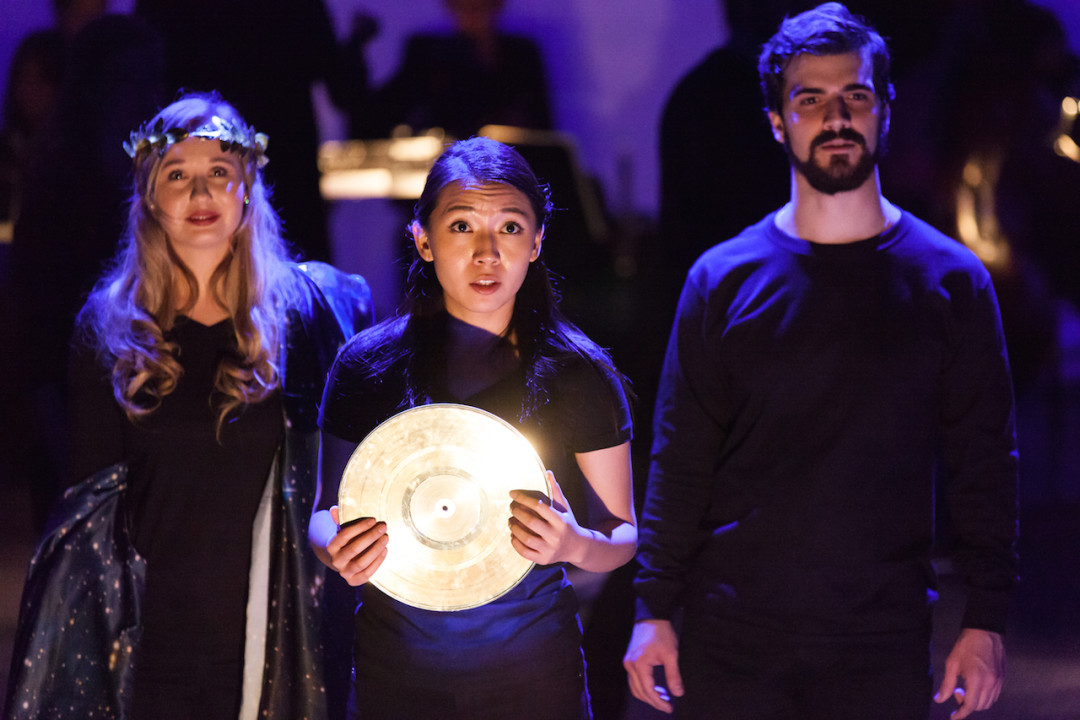
The production was staged in the Revention Music Center (formerly the Bayou Music Center), an open warehouse-like venue that not only hosts concerts, but also roller derby matches and wrestling entertainment. The stage was set with a billowy white backdrop, with the small orchestra, consisting mainly of strings, seated in front. Dressed in black with white sneakers, the cast initially sat in a ring of white chairs surrounding a bed and a small stand with a record player: the bedroom of Becca, portrayed by Pureum Jo, a young girl who daydreams about going into space one day. Along with her classmates, Becca first contemplates Sir Walter Raleigh (Ben Edquist), who sings about the inherent risks of exploration and traveling to the New World. He also mourns the lost Roanoke colonists, and says that the best way to honor them is to continue exploring.

In the second part, Becca is in her Houston bedroom awaiting the return of the Columbia space shuttle, and carries on an imaginary conversation with an astronaut (also sung by Edquist), in which she asks him what he sees, and asks for a role in the mission. She is, of course, devastated upon hearing the news of the shuttle's disintegration, but still determined to go into space.

In part three, Becca looks to the future, to a time when humans are exploring beyond the solar system, looking for habitable planets elsewhere. Lady Columbia (Megan Samarin) appears to tell the astronauts that she is watching over them as she does with all explorers, including those who are lost.


The hardest part to convey here is how original and inspired director Kevin Newbury's staging was. Except for Lady Columbia, all of the singers, dressed in black with white sneakers, remained on stage for the entire 70-minute opera. In addition to the chairs, they each had a simple, stylized astronaut helmet, and used the chairs, flashlights, and even the bedding to various effect. I was moved when I realized that the chairs, now stacked in a jumble, were meant to signify the shuttle wreckage. As the seats were general admission and we got there at the last minute due to dinner plans beforehand, we ended up sitting high up to one side, but I didn't feel we missed anything from that vantage point, because the singers were constantly in motion and facing different directions all the time.

Honestly? I think the only thing I might have been tempted to change would be to dress Lady Columbia differently than the other singers, especially as she did not come on stage until part three. I understand why dressing her the same as everyone else makes sense, but I kept picturing her in a draped white gown to go with the laurel wreath upon her head.

After the performance, we stayed for the "Talk Back", or Q&A, with the creators, and then went to an informal celebratory gathering at the Okra Charity Saloon. This was especially fun for me, because although most of the performers weren't there, I did get to chat with one of the Ensemble cast, Teresa Proctor, who performs frequently with HGOco. I also had a truly fascinating conversation with the opera's lighting designer, Michael James Clark. I know so little about that part of the opera world, and I'm afraid I pestered him with all sorts of questions.

The other nice thing is that I'm finally starting to feel like HGO is not just an opera company, but my opera company. That may sound silly, but for me, it's been harder to feel connected to the opera because the lead roles for the main stage productions are imports, whereas with the ballet, we get to watch the same dancers over the years. But now that we've gotten to see some HGOco productions, we get to see those singers as well as some of the HGO Studio artists. This season, we're going to see all three leads from O Columbia in main stage productions: Megan Samarin as Olga in Eugene Onegin, Pureum Jo as Barbarina in The Marriage of Figaro, and Ben Edquist in Eugene Onegin, The Little Prince, and Carousel. How cool is that?

In the meantime, I have my fingers crossed that O Columbia will be picked up by other companies, especially in places where there is a NASA center or a higher-than-average interest in the space sciences. The Phoenix Opera, for instance, would be ideal for this piece, because both Arizona State and the University of Arizona have planetary science programs, plus the Planetary Science Institute is located in Tucson, just a short trip down the highway. And Phoenix already has a built-in opera audience. Then there's Washington D.C. (NASA Headquarters), Los Angeles (Jet Propulsion Laboratory), and Orlando (Kennedy Space Center). Seriously, more people need to see this.


[Megan Samarin as Lady Columbia, Pureum Jo as Becca, and Bed Edquist as Sir Walter Raleigh/Astronaut. Photo by Lynn Lane.]
Read more!

Friday, September 18, 2015

Opera: It's Not Just for Breakfast Anymore


[Left to right: Librettist Royce Vavrek, composer Gregory Spears, director Kevin Newbury, and conductor Timothy Myers. Photograph by Lynn Lane.]

This isn't quite a review ... not just yet ... but rather a reminder that the world premiere of HGOco's "O Columbia" is less than a week away! If you live in the Houston area, it would be a real shame to miss this -- there are only two performances, and tickets are only $20 each.

As a reminder, HGOco is a branch of Houston Grand Opera. "O Columbia" is their commissioned chamber opera (~70 minutes long) celebrating the spirit of exploration that is such an integral part of Houston. In particular, it honors that spirit not only by remembering past explorers, including the crew of the space shuttle Columbia, but also imagining future explorers as well.

Paul and I have been fortunate enough to have witnessed this opera from concept to realization. Over the last year and a half, we participated in two workshops that occurred during the work's development, one for the libretto written by Royce Vavrek, and one pairing that libretto to composer Gregory Spears' original music. And today I saw their sneak preview at NASA Johnson Space Center, during which they performed several highlights.

Back when we first learned of this project, it seemed like it would be forever before it would finally premiere. Now, I can't believe it's already here! What I'm most excited about is seeing it actually staged. It will be performed at the Revention Music Center (formerly the Bayou Music Center), which is a big warehouse-like space. All of the performers will be "on stage" for the entire opera, but they're not going to be so much on stage as right in the middle of the crowd: it will be performed in the round, with moving ladders and set pieces and stars overhead. The preview today was fantastic; I can only imagine how much fuller the experience will be in this unique setting.

More information here.

[This post affectionately dedicated to those who think all opera is about lovesick, star-crossed couples.]
Read more!

Thursday, July 23, 2015

Houston Grand Opera's "O Columbia" World Premiere tickets on sale

If you're in the Houston area, or can get here, I highly recommend this short (approximately 70 minutes) chamber opera that celebrates the spirit of explorers in general and astronauts in particular. I've been lucky enough to see pieces of this opera all through its development, and it's going to be quite exciting, especially because it's being staged in the round at the Bayou Music Center instead of the usual opera hall.

There are only two performances, on Wednesday September 23 and Thursday September 24. Here's what HGO has to say about it:

O Columbia, a new chamber opera — developed through interviews with Houston-based NASA astronauts, scientists, and engineers — celebrates dreamers and explorers of all kinds. Created by a constellation of rising opera stars and featuring HGO Studio artists, this production takes place in a breathtaking and unexpected setting at Bayou Music Center (across the street from the Wortham Theater Center).

Tickets are general admission and are only $20. Don't miss it! (Link goes to Ticketmaster; you can also call the Bayou Music Center directly.)

Here's an extended article about the opera. I note that Megan Samarin, who was so wonderful as Johanna in HGO's Sweeney Todd this season, sings the role of Lady Columbia.

Read more!

Monday, May 11, 2015

Houston Grand Opera - Sweeney Todd


Last Monday, we attended the Houston Grand Opera Patrons Recital and saw Nathan Gunn, accompanied by Julie Jordan-Gunn, singing a wide variety of pieces, from operatic staples such as the Toreador song from Carmen and Papageno's suicide aria from The Magic Flute (spoiler alert: it has a happy ending) to western ballads and folk music, including "Home on the Range" and "Shenandoah". It was especially fun for us to see Nathan Gunn in such a small venue, because we were about to see him in the title role of HGO's Sweeney Todd later in the same week.

I'm happy to say that this was another case when I was unsure whether I would like a production but then was blown away; it happened earlier this season with Otello and it happened again on Friday with Sweeney Todd. I haven't been overly enthusiastic about HGO's recent trend of adding one or two shows each season that seem to be musical theater rather than opera; I rarely go to TUTS (Houston's Theatre Under the Stars, i.e. traveling Broadway shows) and that's by choice. I didn't care for HGO's Show Boat last season, in part because it took what I think of as a formula musical and added the operatic style, which seemed unnatural in that context. But regardless of my personal taste, I understand why HGO chooses some of these shows, and I think it's smart on their part. These productions have the potential to bring in folks who don't normally attend the opera, and I'm sure it's also fun for long-time opera buffs who are also nostalgic for classic musical theater.

Unlike with Show Boat, I had at least seen the movie Sweeney Todd and so I knew it wasn't precisely a formula musical. The movie wasn't brilliant, in part because much of the casting had little to do with musical ability, but at least the story was interesting. So I thought this production would probably be okay as long as it didn't try to shoehorn too much "opera" where it didn't belong. It turns out I needn't have worried. Not only did it have what felt like the right amount of opera (Johanna's solos were the most formally operatic), the story was even less formula than I remembered from the movie, and far more engaging when seen live.

(I tried to find information, by the way, on whether Sweeney Todd is considered a musical or an opera, and was amused to find this piece by Michael Dale addressing that very question rather humorously.)

For anyone not familiar with this story, it first (according to Wikipedia) appeared as a serial penny dreadful in the 1840s, and has evolved over the last 170 years into various forms, many of them performance-oriented. Sweeney Todd is a former barber, bitter after years of wrongful incarceration in Australia. He has returned to London intent on revenge against the corrupt judge who sent him there to get him out of the way, because the judge coveted Todd's young and beautiful wife. Back in Fleet Street, Todd joins forces with Mrs. Lovett, a woman who runs a failing meat pie establishment and who has a brainstorm about how to deal with a body that Sweeney Todd has need to dispose of....

In spite of the subject manner, HGO's production refrains from going over-the-top, whereas the movie version, created by Tim Burton, takes place in Burton's signature Over-the-Top Land. I don't mind visiting Burton's imagination sometimes, but in this case, the only aspect I liked better in the movie version was that Toby was cast as a quite young boy instead of a young man. I felt that made Mrs. Lovett's maternal attitude towards him more believable and more poignant. I also preferred having a "young boy voice" advertising first Pirelli's haircuts and later Mrs. Lovett's amazing meat pies, although that is not the fault of tenor Nicholas Phan, who played Toby in this live version.

As for HGO's production, I particularly loved several individual performances. Nathan Gunn is not only the perfect baritone for the part, he's the perfect showman: voice, expression, body language.... The entire time I watched him, I marveled at his precision and control. Susan Bullock played Mrs. Lovett, Sweeney Todd's somewhat bloodthirsty accomplice. And hey, here's another clue to that opera versus musical question: her bio in the program says that "Her HGO performance as Mrs. Lovett in Sweeney Todd represents her first foray into musical theater." At least she, then, considers this musical theater rather than opera. In any case, she certainly was a comedic natural in the role, and the audience ate up her (possibly ad-libbed?) humming of The Ride of the Valkyries as she wearily ascended the steps up to Sweeney Todd's barber shop above her own establishment.

Another notable performance for me was Megan Samarin as Johanna, the innocent ward of the lascivious Judge Turpin. (We're going to see Ms. Samarin as Lady Columbia in HGOco's September 2015 world premiere of O Columbia, and I for one cannot wait. We've observed several workshop sessions throughout the creation of this opera, and it's going to be stunning.) Bass-baritone Jake Gardner was well cast as the aforementioned Judge Turpin, and I was thrilled with tenor Scott Quinn as Pirelli. His diction was unbelievable, and his control was equal to Mr. Gunn's.

I should also mention the set and costume design, by Tanya McCallin. Although small parts moved around now and again, this was essentially one set piece, used extremely efficiently. I'd wondered if they would use some kind of sliding chute to transport Mr. Todd's victims to Mrs. Lovett's ovens, and indeed they did. I also thought the "blood" effects were just at the right level -- clearly visible from the furthest seat in the house, but none of the excessive spurting that Tim Burton loves any excuse to use.

On a side note, while I love our particular ticket series for the opera (called "mostly Fridays"), it does come near the end of each run, and I regret that by the time I get to see a production and post a review, it's usually too late to urge other people to go see it. I wish I could tell everyone to go see HGO's Sweeney Todd. If you ever get the chance in the future, don't miss it.

Click here for a detailed review and some background about this production by Opera Warhorses.

[Top photo: Susan Bullock as Mrs. Lovett and Nathan Gunn as Sweeney Todd. Photo property of Houston Grand Opera. Bottom photo: Megan Samarin as Johanna and Morgan Pearse as Anthony. Photo from Megan Samarin's Twitter feed].

Read more!

Monday, May 4, 2015

Houston Grand Opera: Die Walküre

This past Thursday we saw Die Walküre, the second part of Wagner's Ring Cycle. This time last year, when I saw Das Rheingold for the first time, I didn't know what to expect, but this year I had the advantage going in of knowing that I love the look and direction of this production. And I was initially intimidated by Wagner, but I'm finding the music far more accessible than I expected. (I also note that the audience made its appreciation of the orchestra's performance very apparent.)

Not having seen the Ring Cycle before, I can't compare this with other productions, but I find it difficult to imagine that I would find another interpretation more exciting than this one, which is modern and sophisticated. An article in the Opera Cues program written by conductor and Artistic/Music Director Patrick Summers notes that "all of the imagery of the Fura Ring production comes from ancient literature ... if the production resembles science fiction it is only because science fiction shares some of the same sources as the Ring mythology." He continues: "The technological conveyances are modern, like video or Lege's Segway, but their symbolism is not: Wagner's visual imagination was generations ahead of what was physically possible in his era...."

I'm glad to have read that, because it gives me context, yet I still feel free to experience this Ring Cycle as science fiction. I'm new enough to opera that I'm not confident about my opinions, but I can and do talk about science fiction all day long, and I'm becoming more interested in and comfortable with fantasy literature as well. For me, then, this is the best of many worlds.

At some point I really should talk about the opera itself, though! In Das Rheingold, the dwarf Alberich steals gold from the Rhinemaidens (I will never forget the singers in those water tanks!) and forges it into a ring to make himself invincible, which works ... for a while. Wotan, chief of the gods, steals the ring from Alberich but then has to use it to pay the giants Fafner and Fasolt for building Valhalla, the fortress of the gods. In Die Walküre, Wotan has since fathered nine daughters, the Valkyries, with the earth goddess, Erda. With a she-wolf, he has also fathered the twins Siegmund and Sieglinde, but separates them because he hopes that will enable them to one day recover the gold ring for him.

The opera begins when Siegmund and Sieglinde, now adults, meet and fall in love, not knowing at first that they are siblings. Sieglinde's husband, Hunding, demands that Siegmund fight him the following day, and Sieglinde shows him a sword embedded in a tree that no man has been able to pull out. In retrieving the sword, Siegmund realizes Sieglinde is his sister, but still claims her as his bride.

In Act II, Wotan tells his daughter, the Valkyrie Brünnhilde, to protect Siegmund in the coming fight. Wotan's wife Fricka, however, demands that Wotan champion Hunding instead, so Wotan tells Brünnhilde he has changed his mind. She plans to obey, but when Siegmund tells Brünnhilde he will not follow her to Valhalla if Sieglinde cannot go with him, Brünnhilde sides with the lovers. Wotan appears and intervenes by shattering Siegmund's sword, allowing Hunding to kill his opponent. Wotan then kills Hunding and gives chase to Brünnhilde.


The third act opens with the Valkyries gathering slain heroes, represented by a swinging "wrecking ball" draped with live but motionless acrobats (pictured at top of post). The audience literally gasped when the curtain went up on this impressive scene. The Valkyries are afraid to help their sister, and Sieglinde herself wishes she had died with Siegmund, but Brünnhilde tells Sieglinde that she is now carrying Siegmund's child and must survive. Sieglinde escapes, and Brünnhilde stays behind to face Wotan, who punishes her by making her mortal and placing her in a sleep that will last until a man awakens and claims her. At her request, he has her surrounded by fire so that only a brave man will attempt to rescue her.

I know that described like this, the story sounds silly; it's hard to convey how majestic and moving it is when combined with the music, words, and sets. The music and words are probably among the most studied works in opera history, and I don't have the knowledge to analyze them properly, but I will say once again that this opera really was more accessible and moving that I would have expected. I can't wait to see Siegfried next year and Götterdämmerung the year after that, and have I mentioned that I love the way Houston Grand Opera is performing one of these pieces each year? We've been going to HGO for about five years, but this makes it seem more like an ongoing relationship rather than just something we do six or seven times a year. Some of the artists are reprising their roles in more than one of the productions, so we get to know them better, and these performances, at the end of the season, somehow each seem like the event of the year.

As with Das Rheingold, Die Walküre makes extensive use of video screens, showing such things as stylized wolves running through a forest (think of those motion-capture rides, just further away on the stage). The screens also showed the massive tree in which the sword was embedded; at one point the letters of Siegmund's name are drawn up repeatedly through the roots to the ends of even the smallest branches. In this particular story, there is also a fair bit of lightning on screen.

And I don't know what to call them, but another effect repeated from last time was the use of conveyances for the gods and Valkyries to move them around the stage as though they were swooping at will. Even though each of these had two visible stagehands openly manipulating them, I had no trouble getting lost in the effect. (And when we see one of the giants from Dad Rheingold return next year, I hope to see his Aliens power-loader again -- it was awesome!) All of this comes courtesy of La Fura dels Baus, the Barcelona-based theater group that created this production. I note that the set designer, Roland Olbeter, is working on a "full-scale automatic puppet opera with music by Russian composer Elena Kats Chernin to be played by instruments he created" -- that sounds like something I would love.

There was only one effect that wasn't quite all I would have hoped for, and that was the slow speed at which the fire-bearers surrounding the sleeping Brünnhilde lit their torches from one another. I had expected the circle of fire to swoosh up into full flames all at once, but perhaps the passing of torch to torch is meant to go with a particular length of music. Once lit, however, the circle was an impressive visual with which to end the opera, and it will certainly stay in my memory.


[Images are property of Houston Grand Opera.]
Read more!

Tuesday, March 10, 2015

The Wagner Files

Samuel Finzi and Pegah Ferydoni as Richard Wagner and his wife Cosima in "Wagnerwahn" ("The Wagner Files") (2013).

Last night, Paul and I attended a private screening by Houston Grand Opera of "Wagnerwahn", which has been translated as "The Wagner Files". This was an episode in the Die Kulturakte series, and was a 90-minute biographical documentary of Richard Wagner. The reason for this screening, of course, was that HGO will soon be premiering the second of the four Ring Cycle operas, and in opera, although context is not quite everything, it certainly is important.

What I loved most about this documentary was the creativity of its presentation. It mixed interview footage of Wagner historians and even one of Wagner's descendents, Katharina Wagner, with dramatized portions in which actors Samuel Finzi and Pegah Ferydoni portrayed Richard and Cosima Wagner, respectively. It further mixed that with artwork from Wagner: Die Graphic Novel, written by Andreas Voellinger Gebundene Ausgabe and illustrated by Flavia Scuderi. This art has been partially animated, so that the faces and mouths sometimes move, or fire or floods are shown as dynamic instead of static. [Author corrected -- thanks to Lukas for the info!]

To further add to the mix, the enacted scenes made no attempt at historical accuracy in terms of dress and scenic background, so that modern-sounding telephones were utilized often (no cells, thankfully) and modern-day cars zipped by -- that is, unless sleek Audis really did exist in Wagner's time. The characters were dressed dramatically, in a style that I couldn't attribute to a particular time period, and the camera angles were even more dramatic, with long angles and shots up and down through spiral staircases. Wagner and Cosima often spend minutes at a time staring at each other intensely, and there are long moments when Wagner dresses himself in the pink silk fabric for which he had something of a fetish, gazing at himself in the mirror while smelling the roses he also loved.

So what happens when you add all this up? In my mind, you get something like the Frank Miller version (remember Sin City?) of Wagner's life -- or at least the portions of his life most impacted by his second marriage with Cosima. I thought it was fascinating.

And that relationship was indeed the focus of the documentary. Wagner carried on a long affair with Cosima, during which time she, her husband, and their children lived in Wagner's house and she took over the management of his career. Cosimi, who was herself the illegitimate daughter of Franz Liszt, even bore Wagner a child whom she passed off as her husband's for a while. Eventually, though, the affair was outed and Wagner was forced to leave Munich, where he had been quite spoiled by the patronage of King Ludwig II. He moved to Switzerland (again), Cosima joined him there after a time, and they eventually married (by this time they had two additional children together). As the documentary portrayed it, the course of their love was never smooth, in spite of or perhaps because of their passion for one another.

Before seeing this documentary, I knew very little about Wagner's life; I essentially knew that he is regarded as a genius and an anti-Semite. This documentary made abundantly clear that he was both of these things, and that he was also quite a bit more vile than I had imagined. It seems that perhaps with the partial exception of Cosima, he treated the people around him according to how useful he thought they could be to him. The worst case, in my mind, was his blatent exploitation of Ludwig, who clearly was in love with him. Although Wagner was not gay, he didn't shy away from intimacy with other men, so in that regard he was not completely dishonest, but his letters to Ludwig play up that aspect of their relationship shamelessly -- he obviously wanted to give the impression that he felt more than he did, in order to keep the moneybags close by. I don't believe the documentary stated this, and I would want to confirm it elsewhere before believing it entirely, but Wikipedia hints that Ludwig actually considering abdicating his throne to join Wagner in Switzerland, and Wagner dissuaded him. And that makes sense, because the money might well have dried up if Ludwig had given up his throne. I certainly felt sorry for Ludwig, who was completely duped as far as I'm concerned.

The documentary also dealt with the anti-Semitism head-on; in fact, one of the historians said that Cosima's detailed diaries should be required reading for Wagner apologists, because they make it perfectly clear that the couple's shared anti-Semitic views were extreme. There was a long scene in which Wagner sat in a bathtub ranting to Cosima about the Jews while she wrote down everything he said. My impression was that phrases Wagner used were paraphrased from the diaries. Wagner basically said that the Jews couldn't speak or sing properly and were essentially vermin who were stealing "our" art forms. He said that no negotiation was possible, and extermination was the only solution.

I have to say, I felt incredibly uncomfortable during this scene, but I think that was the filmmakers' intention. Wagner's descendant, Katharina Wagner, said that she has to deal with the fact that his hateful bigotry existed and was well documented. If I felt uncomfortable, imagine what it's like to have that legacy permanently recorded in your family's history. For the documentary to shy away from this aspect of his personality would have been a mistake. I noticed that very little mention was made of Wagner's children, and I cringed at the idea of them growing up in that atmosphere. Then I wondered whether Wagner himself developed those views as an adult, or if he grew up hearing such hateful rants in his own family.

Oh, and there was also some information about his music and operas! In fact, the documentary included some footage from the same production of the Ring Cycle that HGO is putting on here in Houston. I greatly enjoyed Das Rheingold when we saw it last year; it was a very modern, science fictional production, and it looks like the rest of it will be along the same lines. In the meantime, for anyone interested in Wagner, I highly recommend the documentary if you can find it.

Read more!

Thursday, January 22, 2015

On This Muddy Water: Voices from the Houston Ship Channel

On Wednesday, my husband and I went to see the fourth and last performance of On This Muddy Water: Voices from the Houston Ship Channel, put on by the Houston Grand Opera under the auspices of their HGOco's "Songs of Houston" project. With music by D.J. Sparr and words by Janine Joseph, this program consisted of a series of seven vignettes set on the Houston Ship Channel in order to commemorate its centennial. It was based on hours of oral history records, and accompanied by a Ship Channel exhibit in the adjoining room that in my opinion was a terrific use of space, with looped camera footage and audio recordings throughout.

The performance itself was given by baritone Heath Martin and mezzo-soprano Lauren Pastorek, who were accompanied by only four instruments: violin, cello, clarinet, and percussion (mainly marimba, I think). The instruments were used to great and often unusual effect, producing some very evocative music. By far, my favorite piece was "Let It Roll", performed by Heath Martin, because it felt like I was listening to a seaman. Even while I was still listening to it, I felt a little sad that there's a very good chance I will never hear that piece of music again in my life. Of course, I imagine that this was all recorded either in rehearsal or another of the performances, but it won't necessarily be widely available. I would like to hear the entire program again so I can absorb more, but especially that piece.

I also loved "He Said, 'Nyet!'", a piece for both of the singers in which the American seafarers tried to share Christmas presents, or make that New Year's presents since the Russian sailors didn't celebrate Christmas, with their Russian counterparts. The Russians initially wouldn't accept the gifts because they had nothing to give in return, but someone helpfully pointed out that they wouldn't mind a little of that vodka.... The vignette both started and ended with bits of one of the oral history recordings, which was a wonderful touch. Part of the reason I loved this piece was that it reminded me of being introduced about ten years ago to the concept of shoeboxes for sailors at Christmas. My employer only did that for one year while I was there, but I still remember the pleasure I took in putting together a box of small gifts for some foreign sailor who happened to be in the port over the holidays.

Those were my two favorites, but I enjoyed the rest of the program as well. I did find it a little hard to reconcile the mezzo-soprano role with the rest. I think it's absolutely right and necessary that stories told of the Ship Channel include the women, whether sailors or dockworkers or simply the families of such, but the formality of female opera vocals made this seem, well, opera-like. That's certainly isn't a bad thing in and of itself, but when the baritone was singing, he really could have just been a seaman with a gorgeous voice, and I was able to think of it as more authentic and less of a trained performance. This isn't meant as a criticism of Ms. Pastorek's voice or performance; it's just that the female operatic style was a little incongruent to me within the visual and aural picture I was building. At the same time I would not want to exclude women's stories, so it's a dilemma I wouldn't know how to solve myself.

According to the program, since 2007, "HGOco has commissioned 16 new works along with countless innovative community projects and has reached more than one million people in the greater Houston area." This particular performance took place in the gorgeous Julia Ideson Library, which was restored in 2011 as part of the Houston Public Library. That was my first time in the building and I thought it was stunning.

I am looking forward with great anticipation to October 2015, when Houston Grand Opera will put on another HGOco-commissioned work, O Columbia, celebrating the exploratory spirit that leads us to continue even in the wake of tragedies such as the Columbia shuttle disaster. Paul and I were allowed to participate in one of the development workshops for this opera, and I think it will be stunning.

On This Muddy Water: Voices from the Houston Ship Channel
Music by D.J. Sparr
Words by Janine Joseph
Lauren Pastorek, mezzo-soprano
Heath Martin, baritone
Melissa Wilmot, violin
Erik Wheeler, cello
Eric Chi, clarinet
Lindsey Höhn, percussion

Read more!

Saturday, December 20, 2014

A New Christmas Carol

Photo by Lynn Lane from the Houstonia Magazine website; Jay Hunter Morris as the narrator in Houston Grand Opera's A Christmas Carol.

You wouldn't think there were any new ways to present A Christmas Carol, but of course there are. I've been aware of a one-man version performed by Patrick Stewart in New York and London upon occasion (what I wouldn't give to see that!), but I hadn't been aware until recently that Dickens himself used to present the tale in one-man performances. And it certainly wouldn't have occurred to me that someone adapt it as a one-man chamber opera. But Houston Grand Opera is doing all kinds of new things these days, so on Friday night we saw the world premiere production of A Christmas Carol by composer Iain Bell and librettist Simon Callow. The role of the narrator was sung by tenor Jay Hunter Morris; he is singing the part for eight performances in all, and will be spelled in two additional performances by Kevin Ray. What a feat of stamina to do this role even once, singing alone for ninety straight minutes!

One aspect of this production I loved was the set, which consisted primarily of a staircase with a door (and occasionally a window) at the top, and a white-canopied bed that appeared during the scenes that took place in Scrooge's bedchamber. The staircase was made of segments that could be moved together or alone by the crew of actors/stagehands who were dressed entirely in black so that they remained almost completely unobtrusive. Geometrically minimalist chairs, constructed and placed in ways to deliberately exaggerate perspective, were very effective, and when the Ghost of Christmas Present points out the starving children who are Want and Ignorance, two almost-invisible figures write those words graffiti-style in dripping white paint on the side of the black staircase. The set pieces were moved just often enough to keep the show dynamic without going overboard. In fact, the only visual elements I would have changed were Marley-as-doorknocker, which looked odd, and Scrooge's costume itself. He wore a suit and suspenders of (to me) indeterminate period, when I would have liked just a hint of the Victorian there, which I think would have worked even with the stark set.

In terms of the music itself, I thought the use of bells and chimes in the right places was extremely evocative, but there were more times when the music didn't make sense to me than times it did. I enjoyed Morris's overall performance, however. His face and hands were particularly expressive, and his diction was amazing -- I don't think there's ever been a time when I've needed the surtitles less. But I did have trouble understanding whether and how the vocal thread was connected to the orchestral music. I asked my husband if he thought some formal education is required to appreciate atonal work; he said he thought it was more a matter of taste, but I do still think the majority of listeners find atonal music difficult to parse compared to melodious work. I would like to hear the orchestral music alone to see how I feel about it without being distracted by the vocal thread, which just seemed random to me at times.

I also have to admit that A Christmas Carol is also a story I've always struggled with a bit. I enjoy Scrooge's transformation as much as anyone, but I often wonder how genuine it is when it often seems that the simple sight of his own gravestone scares him into being nice. Since he's still going to die, I'm sure the point is the difference between dying alone and unmourned versus loved and missed, but that does not always come across completely, and it can be argued that he is buying that future posthumous love. However, in this production I felt like his transformation was a little more gradual over the visits of all three ghosts versus the flip-a-switch version we see in some portrayals of the story, and hence a little more believable. In many ways, though, I don't think that this particular method of portraying the story is necessarily as effective as straight dramatic interpretation.


Read more!

Monday, November 17, 2014

Opera Times Three

Photo by Lynn Lane from the Houstonia Magazine website; Ailyn Pérez as Desdemona and Simon O'Neill as the title character in Houston Grand Opera's Otello.


Opera Times Three

By chance, my husband and I happened to see three different operas in nine days: Houston Grand Opera’s Otello on Friday November 7 and their Così fan tutti on Saturday November 15, and Arizona Opera’s Rigoletto in Phoenix on Friday November 14. In the days between, we were attending the Division of Planetary Sciences conference in Tucson, and had found out that one of my husband’s planetary science colleagues would be performing in the chorus of Rigoletto. Naturally we didn’t want to miss the chance to see him, and had a wonderful time meeting some of the chorus members afterwards in our hotel bar.

Needless to say, this was all a bit frenetic, especially Saturday, when we had to drive from Phoenix to the Tucson airport, then fly to Houston, then drive straight from the airport to HGO. (I literally changed into a dress in the 50-degree rainy weather in the Park N Fly parking lot. Hey, I’m not proud!) Miraculously, especially considering that United managed to put another flight’s luggage onto our plane and then needed forty minutes to correct the error, we made it just in time for curtain.

But starting back at the beginning... The first opera of HGO’s 2014-15 season was Giuseppe Verdi’s Otello (libretto by Arrigo Boito). I have to admit that I was not overly excited to see this, mainly because my husband and I were both exhausted from trying to finish the draft of a planetary science textbook chapter that day, after several late nights working on it. Also, back when I was a bratty college student and didn’t appreciate Shakespeare as much as I do now, I took a seminar class in his tragedies, and remembered our professor telling us that the plot of Othello could be described as “someone drops a handkerchief and all hell breaks loose.” So much of opera and theater is based on misunderstandings and misapprehensions, and I just didn’t anticipate that I could take this story seriously and be invested in it.

I was completely wrong.

I don’t know exactly what it was about this production, but I was completely engrossed in the story and I truly bought into its tragic nature. I was convinced that Otello (Simon O’Neill) and Desdemona (Ailyn Pérez) were very much in love, and that they were the victims of a manipulative, evil bastard (Marco Vratogna as Iago) who sows chaos for the sake of chaos. Of course, Otello is an idiot for believing Iago, but it still rang true rather than feeling contrived, in contrast to the plot of (for instance) Rigoletto. Otello’s sets and chorus scenes were impressive, and I absolutely loved the scene in Act II with the children’s chorus. Although I don’t believe in gods or saints, or in the idea that beauty is inherently virtuous, when the ethereally beautiful Desdemona greets a crowd of children while they sing in their lovely high voices, well, that’s as close as I get to a feeling of religious awe. I will definitely be buying a recording of Otello, and also have plans to explore the play further in both audio and visual forms. (A note of interest: Wikipedia tells me that Shakespeare’s Othello, written in approximately 1603, was based on an Italian short story “Un Capitano Moro” ("A Moorish Captain") by Cinthio, first published in 1565.)

A final note on Otello: I heard more than one person mention they were back to see it a second time during the run. The night we attended was the last performance; if we had gone to an earlier one, I would have been very tempted to come back a second time as well.

Our second foray was a visit to the Arizona Opera in Phoenix for Rigoletto, also by Verdi. The libretto is by Francesco Maria Piave, based on Victor Hugo’s play Le rois’amuse, which Wikipedia translates as “The king amuses himself” or “The king has fun.” I quite liked this production; it had lovely costumes and sets, and, well, the music was Verdi.

Unlike Otello, however, in this case I really had to struggle to get past the plot. The title character is court jester to the Duke, a notorious womanizer. Rigoletto mocks a count, whose daughter the Duke had courted; the count curses Rigoletto, who shortly thereafter meets an assassin, Sparafucile, and ponders the idea of hiring him. Rigoletto then returns home where he meets his beloved daughter, Gilda, whom he essentially keeps locked up. It turns out that the Duke had spied Gilda at church and has followed her home. They profess their love for one another but Gilda is ignorant of the Duke’s true identity. The hostile men of court decide to kidnap Gilda, believing her to be Rigoletto’s mistress, and they trick Rigoletto into helping them by saying they’re kidnapping the count’s wife.

And all of this is just in the first act.

Confusion aside, it’s pretty hard not to be disgusted by almost everyone’s behavior. The courtiers think it’s fine to kidnap Rigoletto’s mistress, but it’s unclear to me if they would have taken Gilda if they’d known she was his daughter. I don't think they would have, because I think perhaps in their minds the difference is that a woman who is a mistress is already “ruined,” whereas kidnapping a virtuous young virgin would actually ruin her, since a woman who has been at the mercy of a group of men such as this will at least have her reputation devastated even if she is not actually despoiled. But while we dislike the men at court for deciding it's okay to kidnap a mistress (who are the very least will be terrified at the possibility of rape), how are we supposed to remain sympathetic to Rigoletto later when he too goes along with the kidnapping, believing the count's wife to be the victim? Just because the count was an ass to him, his wife must suffer?

I’m not suggesting that the storyline be changed at this late date, or that there aren’t other things to appreciate about this or any other opera with a less-than-stellar plot. But like I said, it can be hard to get past these things. Fortunately, I found the second and third acts a lot more palatable: Act II consists of Rigoletto trying to get Gilda back, Gilda defending the Duke, and Rigoletto swearing vengeance (remember the conveniently met assassin from Act I?). In Act III, Rigoletto proves to Gilda that the Duke is unfaithful, as he is currently trying to seduce the assassin’s sister, Maddalena. Gilda decides she loves the Duke anyway, and upon overhearing that the assassin plans to kill the Duke, she puts herself in the Duke’s place and dies to save him. Rigoletto, realizing that his own plans for vengeance are ultimately responsible for killing Gilda, believes that the count’s curse has come to terrible fruition.

Actually, in describing Acts II and III, I realize that the plot really doesn’t become any less ridiculous than it was in Act I, but somehow the music manages to better transcend the silliness. It’s really quite wonderful when Rigoletto, Gilda, the Duke, and Maddalena sing simultaneously, and it's easy to get swept up in the story for a short while, at least. But Gilda is the only truly sympathetic character (Maddalena is fine right up until she says that they should simply kill a beggar in place of the Duke). And it's hard to respect even Gilda when she’s willing to die for an unfaithful jerk that she just met -- here is where the motivation is a little hard for a modern audience to swallow. Dying for love isn't a problem in itself, storywise, but it’s a little more meaningful when the person deserves the sacrifice being made for him. So again, thank goodness for the music, and the overall production values of this performance.

Last but not quite least was HGO’s Così fan tutti, composed by Mozart with libretto, in Italian, by Lorenzo Da Ponte. (I’m beginning to think that the next language I should study after German and Japanese is Italian.) This is a comedy and actually very amusing, but it’s very, very long for the amount of story there is to be told. Two young soldiers named Guglielmo (Jacques Imbrailo) and Ferrando (Norman Reinhardt) are bragging about the virtues of their fiancées when their older and more experienced friend Don Alfonso (Alessandro Corbelli) makes a wager saying he can prove that the women, like all women, will be unfaithful when given the opportunity.

At Don Alfonso’s urging, Guglielmo and Ferrando tell their lovers they must go off to battle but they quickly return, ludicrously disguised as Albanians. Don Alfonso enlists Despina (Nuccia Focile), the ladies’ maid, to help things along as the two men each try to court the other’s fiancée. At first, the sisters Fiordilgi (Rachel Willis-Sørensen) and Dorabella (Melody Moore) resist, Fiordilgi with noticeably more vigor, but the “Albanians” perform increasingly silly antics, such as pretending to drink poison when the ladies will not return their affection. Eventually the men wear them down, even Fiordilgi, and they are on the verge of marrying when fanfare announces the “return” of the women’s original lovers and all is confessed and forgiven.

Good parts first: this performance was full of truly enjoyable comedic acting. The soldiers are laugh-out-loud funny as they twirl mustaches and capes; the sisters are amusing in their indignation and later their rationalization; and Despina, for me, sort of stole the show. The music is good, of course. Every one of the six main players has lengthy solos, each couple sings together (five couples in all, once you take the musical romance chairs into account), and the entire group sings together. The problem is that they do it several times, imparting the same sentiments over and over. If this opera were shorter by a third, I think it would make for a delightfully entertaining evening, but it is hard to sit still for so long with so little story as an anchor, no matter how pretty the music. I certainly can’t fault the performers, however; I thought they were well cast and I enjoyed their voices.

That said, I do think it would have been a lot more amusing if the two couples realized they were more suited to their new lovers than the original ones -- and physically, the new couples looked better together than the old.

There was one other thing that puzzled me: the costuming and actions of the small chorus. When Act I opens, the three male leads appear to be in a tavern, and Don Alfonso has a prettily dressed but bald woman sitting on his knee. In the background, additional chorus members do things -- another woman wearing a bald cap whose coloring is out-and-out yellow for some reason appears to be putting on make-up and then possibly sneezing. Was she supposed to be a performer? Was she sick? In addition to this performance, I had seen the dress rehearsal of Così a few weeks earlier, and both times I was equally distracted, trying to figure out who these people were and what they were doing. For a moment I had this strange conviction that they must be dying of consumption or jaundice or both while preparing backstage for a performance at the Moulin Rouge, but of course that wasn't the case, and in the end I never could make any sense of it. While I found this opera’s sets to be simple yet quite effective, I just could not figure out the use or purpose of the chorus other than to provide some of the means for Don Alfonso's manipulations. It's possible that I'm missing some historical context; I certainly don't fault the choral performers for this.

On a side note, it was fun for me to see another opera company that operates quite differently from ours. At HGO, for instance, the six main operas of the season are grouped together into three “rep periods,” so that the company overlaps and alternates the performances. On the plus side, of course, this gives the performers the chance to rest their voices, but logistically, it also means that they have to switch out some very elaborate sets with not much turnaround time. I’ve begun to enjoy watching how the opera season -- and the ballet season, since they perform in the same venue -- falls into the same scheduling patterns year after year. (Don’t ask me why; I find comfort in patterns!) In Arizona, they alternate the main performers within a single opera rather than overlapping two different shows. They'll perform Rigoletto a total of five times; the Duke and Rigoletto roles were each given a 3-2 split between performers while the Gilda we saw, Sarah Coburn, will have been spelled once by a studio artist named Andrea Shokery.

To conclude, I do feel as though I learn something every time I go to the opera, but on the other hand I realize just how very little I know. I still feel awkward “reviewing” opera when I have so little knowledge of the history and culture behind it, and no real ability to discern between good singing and great singing. Because of that, my thoughts are based almost entirely on my response to the story, the sets, the costumes, the acting, and the appeal (or lack thereof) of the music to my personal taste. In other words, I’m the exact opposite of a sophisticated opera-goer. But I’m trying, and enjoying the experience.


Photo of Rigoletto by Tim Trumble Photography, from the Arizona Opera photo archive.

Photo of Così fan tutti by Lynn Lane, from the Houstonia Magazine website: Norman Reinhardt (Ferrando), Melody Moore (Dorabella), Rachel Willis-Sørensen (Fiordiligi), and Jacques Imbrailo (Guglielmo).
Read more!

Saturday, September 6, 2014

A Tale of Two Art Forms: Houston Grand Opera and the Houston Ballet


Yesterday my husband and I had a great experience, or two great experiences, really, in an amazing juxtaposition. Over lunchtime, we attended a workshop by HGOco, which is “Houston Grand Opera’s unique initiative that connects HGO to the community through meaningful collaboration." A lot of what HGOco does consists of workshops, opera camps, student-only performances, etc., but they also commission works particularly relevant to the local community. Along those lines, in the fall of 2015, HGO will premiere O Columbia, a chamber opera telling the story of the exploring spirit in general and the Columbia shuttle tragedy in particular.

At yesterday’s workshop, we listened to a libretto reading given by professional actors for the material as it exists to date. The entire creative team was in attendance, including librettist Royce Vavrek, composer Gregory Spears, HGOco Music Advisor David Hanlon, and director Kevin Newbury. The purpose of the workshop was for the creative team to get feedback from several opera enthusiasts as well as current and former NASA employees, including at least one astronaut. This allows them to assess whether the piece is moving in the right direction before the work goes further, particularly the musical composition.

For us, it offered an extremely rare opportunity to see the early stages of the creative process in action. I didn't know that the libretto comes before the music, and now that I know, I still can’t imagine the complexities of having to write words that will be sung when you don’t yet know the melody (although of course they have been collaborating throughout the process, so they’re on the same page in that regard), or the difficulty of fitting the music around words while also carrying certain melodic themes throughout the entire work. We've had season tickets to the opera for a few years now, and I know that I will look at productions differently after having seen some of what goes into them.

Without going into further details, I have to say that if you live anywhere in Texas, when the time comes you should make every effort to get to Houston to see O Columbia. (Although you don't have to live in Texas -- there are lots of flights to Houston every day!) It’s going to be an amazing opera, one that’s incredibly personal to anyone even remotely affiliated with NASA or simply interested in human spaceflight. It will be even more personal to those of us who live in Houston, but it’s not limited to that. So remember: Fall 2015. This is going to be really special, and shouldn’t be missed.

By complete coincidence, yesterday evening we also attended a talk presented by the Houston Ballet. Every season, the company puts on three full-length ballets and three mixed repertoire performances. This year, all three full-lengths will be Shakespeare (how fun is that?!), so last night’s Ballet Talk was about interpreting Shakespeare through dance. I hadn’t really thought about it before, but it’s a fascinating topic, because Shakespeare is all about the language, none of which is available in dance. Houston Ballet will be performing A Midsummer Night’s Dream, Romeo and Juliet, and The Taming of the Shrew over the 2014-15 season, and now I can't wait to compare them to the plays. (Tangent: a fun coincidence is that the first opera I ever saw was HGO’s performance of Benjamin Britten’s A Midsummer Night’s Dream. It’s really interesting to see the same story as both opera and ballet; I believe the only other story I’ve seen in both forms is Madame Butterfly.)

For this Ballet Talk, the panel of experts consisted of Artistic Director (and choreographer) Stanton Welch, Managing Director Emeritus and ballet historian Cecil C. Conner, Jr., and University of Houston-Clear Lake literature professor Dr. Elizabeth Klett. The talk began with some interesting literary context from Dr. Klett. For instance, who knew that the story was not original to Shakespeare, but came instead from what Dr. Klett said was a "frankly terrible" 1562 poem by Arthur Brooke titled "The Tragicall History of Romeus and Juliet"? Dr. Klett gave us lots of other interesting tidbits, and was followed by Mr. Conner's overview of various Shakespearean ballets over the years, accompanied by some lovely photographs of famous performances.

My favorite part of the talk, though, was when Stanton Welch spoke about the new Romeo and Juliet he’s creating that will premiere in the spring. He said that while you might expect the artistic process for a new production to begin with the choreography, it’s actually the opposite: you start with the sets (built with models down to opening doors and cloth backdrops) and the costumes and don’t get down to the characters and the choreography until much later. This production's scenery and costumes have been designed by Roberta Guidi di Bagno (go here for a great blog post by Laura Lynch, Houston Ballet Wardrobe Manager, on working with the designer and shopping for fabrics in Rome).

Another thing Mr. Welch discussed was his intention to reestablish many of the play’s minor characters that have been eliminated from most dance productions. Another part of the process is settling on intentions and motivation; he said that in watching several versions of the play, he’s noticed that Mercutio’s famous speech has been played as slightly mad, as humorous, as angry…. Which of those will ultimately fit the version he wants to tell, and how to portray that in dance?

As with the opera workshop, I felt we were getting a look at the creative process in action. Especially when re-creating one of the most performed stories in recent history, how do you keep all that in mind and manage to make it all come together in the end, into a work that has its own personality?

And to think all this time I've thought that simply writing a short story was difficult. It is difficult, to be fair, but I have to admit that I'm amazed at what goes in to these other, extremely complex forms of storytelling. I’m glad there are such talented people out there who are so devoted to these two art forms.


[Costume design sketch by Roberta Guidi di Bagno.]
Read more!