Showing posts with label science fiction. Show all posts

Monday, January 31, 2022

Short Fiction read in January 2022

cover image of Clarkesworld magazine issue 178
Short Fiction read in January 2022
Image by Alex Myers on Pixabay; used with permission

I've restarted my short-story-a-day reading, and am excited to share a few of the excellent stories I've read this month. Basically, my goal is to read at least one story for every day of the year, but I often read more than one, especially when it comes to flash fiction. This month, I read 47 stories (including 22 flash stories, 23 short stories, and 2 novelettes) for a total of 105,669 words. When you think about it, it's really not that much, because lots of novels are 100K words and I can certainly read more than a novel a month! Anyway, here are my four favorite stories from my January reading -- and there were lots more that came very close.


"The Falling" by M.V. Melcer
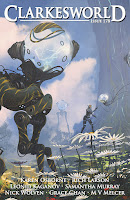
cover of Clarkesworld 178

Length: 4,780 words (short story)
Category: Science fiction
Where Published: Clarkesworld #178
When Published: July 2021
Read here

This story makes me want to point and shout, "This! This is why I read science fiction!" M.V. Melcer's "The Falling" begins with the main character as a seven-year-old, living with their parents and twin sister on a space colony made of rings that is just barely escaping the ... something that has consumed the sun and Earth and is making its way through the rest of our solar system. It's wholly original, but on some subconscious level it remidned me a little of Ted Chiang's work, in that it's based in hard science that shapes the characters' lives and at the same time acts as a metaphor. The world-building is wonderful, the characters are fully realized, and it packs an emotional wallop.


"I Wear My Spiders in Remembrance of Myself" by Kel Coleman

Length: 4,671 words (short story)
Category: Fantasy - magic realism
Where Published: Apparition Literary Magazine When Published: August 5, 2021
Read or listen here

This is a gorgeous story about trauma, relationships, vulnerability, the cumulative effects of racism.... Obviously spiders are involved, but other than that I don't even want to summarize the plot, because people need to read this story, not have it described to them. Suffice it to say that I gave a five-star rating (out of five) to all four of these favorites, including this one, and there's a reason for it.


"The Last Civilian" by R.F. Sand
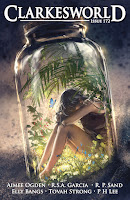
cover image of Clarkesworld magazine issue 172

Length: 7,590 words (novelette)
Category: Science fiction
Where Published: Clarkesworld #172
When Published: January 2021
Read or listen here

In this novelette, a decanted infantry soldier designated as Zeta73 meets the higher-ranking Eta1, who is being groomed as the legendary General Volantius's replacement. Their friendship, while not forbidden, is highly irregular, not just because of rank but because decanted soldiers generally don't engage in superfilous pursuits, especially when they are at war with the alien planet's native species, the Uilai. This is a rich, inventive story that I highly recommend.


"Can You Tell Me How to Get to Paprika Place?" by Michael R. Underwood
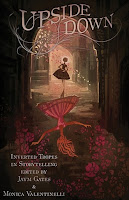
Length: est. 5,500 words (short story)
Category: Science fiction
Where Published: Upside Down: Inverted Tropes in Storytelling (anthology)
When Published: 2016

I can't imagine how someone managed to come up with such a bizarre, wonderful idea, let alone actually pull it off. Two former children's show characters, repurposed into weapons for a war that led to a post-apocalyptic America, wearily try to get their fallen comrades back to Paprika Place, and yes, it is what you're thinking. Beautifully done. I don't think this story is available individually, but the anthology e-book is only $4.99, and this story alone is worth it. I've read two other stories in the book so far, and based on their quality, I'm eager to check out the rest.


Complete list of stories read in January 2022:
(alphabetical by author)
  1. "A Stirring of Wings" by Ken Altabef (2022)
  2. "God 47" by Laila Amado (2022)
  3. "The Future History of Your Body" by Davian Aw (2022)
  4. "Teleportitus" by Mark S. Bailen (2022)
  5. "A Telephone Call for Genevieve Snow" by Carmel Bird (1995)
  6. "Mind the Meniscus" by Jason P. Burnham (2022)
  7. "Werewolf" by U.M. Celovska (2022)
  8. "Ootheca" by Mário Coelho (2021)
  9. "I Wear My Spiders in Remembrance of Myself" by Kel Coleman (2021)
  10. "Binaries" by S.B. Divya (2016)
  11. "Help Her Fit In" by Tamlyn Dreaver (2022)
  12. "The Last Dangerous Vision" by Glen Engel-Cox (2021)
  13. "Doomsday Derby" by micah epstein
  14. "Flesh of my Fin" by Shannon Fay (2022)
  15. "Burning Bright" by Shanna Germain (2016)
  16. "Counterparts" by Andrew Hansen (2022)
  17. "The Devil You Don't Know" by Dave Henrickson (2022)
  18. "Reigning Cats and Human Doggies: How Humans Learned to Heel" by Alicia Hilton (2021)
  19. "Shattered Petals of Celadon" by M.K. Hutchins (2022)
  20. "Moon-Boy" by Jess Hyslop (2021)
  21. "Bride, Knife, Flaming Horse" by M.L. Krishnan (2021)
  22. "The Last Caricature of Jean Moulin" by Andrea Kriz (2021)
  23. "Resistance in a Drop of DNA" by Andrea Kriz (2021)
  24. "Ascend, Exalt, Love, Propagate, Rise!" by Sarah Kumari (2021)
  25. "Invasion" by Candice R. Lisle (2022)
  26. "Commuting" by S.A. McKenzie (2022)
  27. "The Falling" by M.V. Melcer (2021)
  28. "My Dreams Have Been Weird Since the Magpies Arrived" by Wendy Nikel (2021)
  29. "Dissent: A Five-Course Meal (With Suggested Pairings)" by Aimee Ogden (2022)
  30. "Last Flight" by Bret Parent (2022)
  31. "Little Lila" by Susannah Rand (2021)
  32. "The Shape of Wings and Feathers" by Jenny Rae Rappaport (2021)
  33. "Leader of the Pack" by Alter S. Reiss (2022)
  34. "Cures for Hiccups" by Rachel Rodman (2022)
  35. "Tevye From Fiddler on the Roof, Now a Rich Man, Receives a Letter From His" by Stephen Ruddy (2022)
  36. "The Last Civilian" by R.P. Sand (2021)
  37. "The Future Library" by Peng Shepherd (2021)
  38. "No One at the Dock" by Gu Shi (orig. 2020; English translation 2022)
  39. "The Ansible Light" by Chloe Smith (2022)
  40. "Tourists" by Marlan K. Smith (2022)
  41. "The Tangled Web" by Ferrett Steinmetz (2016)
  42. "Portuguese Essay" by George Tom (2021)
  43. "The Last Library" by Brian Trent (2021)
  44. "Can You Tell Me How to Get to Paprika Place?" by Michael R. Underwood (2016)
  45. "2021" by Sean Vivier (2022)
  46. "Turning the Tide" by Dawn Vogel (2022)
  47. "The President's Advisor" by Barry Yedvobnick (2021)

List of the sources from which these stories came: (alphabetical by anthology title, magazine title, website name, etc.)
  • Apparition Literary Magazine
  • Beneath Ceaseless Skies
  • Clarkesworld
  • Daily Science Fiction
  • Departure Mirror Quarterly
  • Escape Pod
  • Every Day Fiction
  • Lightspeed
  • Metastellar
  • McSweeney's
  • Nature
  • ParSec
  • Riddled with Arrows
  • Solarpunk
  • Strange Fruit (anthology, Penguin Australia, 1995)
  • Strange Horizons
  • Tor.com
  • Upside Down: Inverted Tropes in Storytelling (anthology, Apex, 2016)
Read more!

Tuesday, April 2, 2019

Short fiction read in February 2019

Short Fiction read in February 2019

This blog post is dreadfully late; here it is April 2, and I'm just now posting about my February short fiction reading. I've kept up with the reading throughout March, but the posting, not so much. But I'm determined to keep with this project, even if I'm a little slow posting about it.

At any rate, my reading for February was a little unusual for me. As usual, I mostly read SF&F in February, but only one of the pieces I want to talk about falls in that category. The other two are a contemporary Japanese story in translation, and a British period piece published around 1927. I'll start with that last one.


"O Tempora! O Mores!" by E.M. Delafield

Length: 6,353 words (estimated based on word/page count)
Category: British period fiction (short story)
Where Published: The Entertainment and Other Stories (collection)
When Published: 1927 (anthology date)
Link: N/A

Years ago, I fell in love with E.M. Delafield's novel Thank Heaven Fasting -- long enough ago that I don't recall how I happened to stumble upon it. My copy is a Virago Modern Classic edition, and at one point I casually began acquiring those, but I can't remember if I started collecting them because I loved Delafield's novel and hoped to find more in the same vein, or if I was already collecting them and that's how I happened to come across Delafield's book.

No matter. I love that book. Love it. So much so that I can quote a great many lines from it. It's about a girl named Monica who makes her debut -- formally presented at court, to royalty, in London in the early 20th century. Monica's entire upbringing has been centered on making her attractive to eligible men, in a world where there aren't enough men to go around and girls often "get left."

It sounds so simple. But the story is beautifully complex.

In the intervening years, I've read additional Delafield novels; I'm even listed as "producing" the novel Consequences on Project Guternberg because I proofread the OCR text for the Girlebooks website several years ago. But it wasn't until last year that I learned she published at least two short story collections. Interlibrary Loan to the rescue! I read Love Has No Resurrections and Other Stories (1939) in September 2018, and I just finished The Entertainment and Other Stories (1927) a few days ago. Surprisingly to me, I found the earlier stories to be stronger. In both of these collections, most of the individual stories don't stand out in an obvious way, but all I have to do is read my one-line summary of each story and I can easily recall its characters and many of its details. This is in contrast to the fact that I often forget a genre story I've read within a day, if it doesn't truly grab me. In any case, Delafield writes of society girls, convent-raised girls, servants, and landladies, and makes them all come to life. She's realistic about class differences and rarely goes for the fairy tale ending. And I've only just begun to scratch the surface of her work.

As it happens, I only read three of the works in The Entertainment and Other Stories in time for February's reading round-up; the rest will be listed with my March short fiction reading. Of the three I read in February, I wanted to mention "O Tempora! O Mores!" in particular. In this story, Amabel Forrester is an upper-class young woman who does what such young women do; that is, she arranges flowers, does needlework, and waits for someone to propose. (This isn't far off from Austen's work in that regard.) By chance, she meets a young man while volunteering at an annual summer school day party for children that takes place at the vicarage. The young man, however, is the eldest son of a semi-local farming family; he had gone to Canada to seek his fortune and is back for a family visit. But upper class girls are not meant to mingle with farmers, so.... but I won't give away anything else on the off chance that someone wants to read up on Delafield. In the end, while I've come to love Jane Austen's work, I find Delafield's prose style much more accessible.

I'm so glad I was able to get this through Interlibrary Loan, because I truly enjoyed almost every story, which I can rarely say about any collection or anthology.


Convenience Store Woman by Sayaka Murata

Translated from the Japanese by Ginny Tapley Takemori
Length: 33,660 words (estimated based on word/page count)
Category: Contemporary Japanese fiction (novella)
Where Published: Grove Press (standalone work)
When Published: June 2018 (English language edition)
Link (Amazon book page)

This novella follows Keiko Furukawa, a Japanese woman in her thirties who is still working part-time at a convenience store instead of either getting married or pursuing a "real" job -- that is, "real" as defined by her parents and most of Japanese society. Even Keiko's managers, who value her absolute reliability and pride in her work, urge her to find something better. But while Keiko is not necessarily happy in the convenience store, she's comfortable there, and that's not nothing. The store's envirnoment supplies her with mechanisms for dealing with the social cues that she rarely understands. And the rules about engaging with customers are plain and simple, which is just what Keiko needs to fit in.

Nonetheless, the social pressure to find some ambition continues to grow, so Keiko tries an experiment: letting a man, whose employment at the convenience store is very short-lived, stay in her apartment so she can pretend she has a live-in boyfriend. If I have any complaints about this novella, it's that the man is such a jerk, but that is kind of the point. At any rate, this is a quick and compelling little read.


"Counting Days" by Patricia Lundy

Length: 989 words
Category: Science fiction (flash fiction)
Where Published: Daily Science Fiction
When Published: February 1, 2019
Link (free to readers)

Two young woman, one who cuts herself and one who hurts herself in a decidedly more science fictional way, learn to support each other in their efforts to cope with their self-harm compulsions.

In the past few years, I've gotten to know several people experiencing long-term, significant emotional pain, and I felt that this short piece captures that reality quite well. That's one of the things I love about speculative fiction -- it often examines very familiar topics in new ways.


Complete list of stories read in February 2019:

(alphabetical by author)
  1. "Bleed" by Brenda Joyce Anderson (2019)
  2. "Unraveling" by K.G. Anderson (2016)
  3. "Sonny Liston Takes the Fall" by Elizabeth Bear (2008)
  4. "Local Senior Celebrates Milestone" by Matthew Claxton (2019)
  5. "Taste" by Roald Dahl (1945)
  6. "The Entertainment" by E.M. Delafield (ca. 1927)
  7. "Incidental" by E.M. Delafield (ca. 1927)
  8. "O Tempora! O Mores!" by E.M. Delafield (ca. 1927)
  9. "Yona's Android" by Michelle Denham (2019)
  10. "The Debt" by Meg Elison (2018)
  11. "Childhood of a Famous Military Leader" by Jay Gershwin (2019)
  12. "Evening Star" By Paul Alex Gray (2017)
  13. "Give the Family My Love" by A.T. Greenblatt (2019)
  14. "Only in New York" by Libby Heily (2019)
  15. "Cherubim" by Julia Heslin (2019)
  16. "The Magician's Clown" by M.L. Kejera (2019)
  17. "Universal Print" by Fonda Lee (2015)
  18. "Counting Days" by Patricia Lundy (2019)
  19. "Convenience Store Woman" by Sayaka Murata (2016 Japanese; 2018 English)
  20. "Reach Out and Touch Someone" by Val Nolan (2019)
  21. "In September" by Aimee Ogden (2019)
  22. "A La Carte" by Joy Kennedy-O'Neill (2019)
  23. "Painwise" by Robert Reed (2019)
  24. "The Experiment" by Michael Adam Robson (2019)
  25. "How Much is Too Much?" by Paavo Saari (2019)
  26. "Gifts of Prometheus" by Alex Shvartsman (2019)
  27. "The Goblin" by Christina Sng (2019)
  28. "Ardent Clouds" by Lucy Sussex (2008)
  29. "3 Minutes" by Adam Walker (2019)
  30. "The Tentacle and You" by John Wiswell (2019)
  31. "Wet" by John Wiswell (2014)
  32. "Lullaby" by Lynden Xu (2019)


List of the sources from which these stories came: (alphabetical by anthology title, magazine title, website name, etc.)
  • Clarkesworld
  • Crossed Genres
  • Curious Fictions (fiction reprint website)
  • Daily Science Fiction
  • The Del Rey Book of Science Fiction and Fantasy (anthology, 2008)
  • Diabolical Plots
  • The Entertainment and Other Stories (collection by E.M. Delafield, 1927)
  • Every Day Fiction
  • Food Fictions (audio reprint anthology, 2007)
  • Ladies Home Journal
  • The London Reader
  • Nature


I'm going to hold off posting stats for February because I've messed up somewhere on my numbers, and I need to figure out where. (That's actually a big part of why this post is so late!)


Read more!

Monday, February 4, 2019

Short Fiction read in January 2019


Short Fiction read in January 2019

Image from https://torange.biz/ used under a CC license


New year, new re-start of the Great Short Fiction Reading Project!

Here's what's different this time around: In addition to picking stories of various lengths from different sources, I plan to read every story published this year by Daily Science Fiction (five days a week), Every Day Fiction (seven days a week), and Nature's "Futures" section (once a week). Those are all flash (except for the occasional DSF story that tiptoes past the 1,000 word mark), so it should be manageable. I'm also going to post monthly stats, which I'll put way down at the bottom of the post so nobody has to see them if they don't want to.

Here's what's staying the same: each month I'll blog about my favorites from that month's reading, and list all the remaining stories I've read and the collective sources they came from.

These are my four favorites of the 85 stories I read during January (alphabetical by author):


"Terra Forms" by Jennifer Campbell-Hicks and Justin Adams

Length: 5,230 words
Category: Science fiction - hard (short story)
Where Published: Perihelion
When Published: 2018-04
Link (free to readers)

This is hard SF with emotions, some neat technologies I haven't seen elsewhere in fiction, and themes of terraforming and colony ships. And it's well-written. In other words, there was no way I was not going to love this story. There's one plot "conflict" element at the end that I wasn't initially sure I liked, but the more I think about it, the more I realize it adds a layer to a story that otherwise might have been too "tidy."


Read more!

Thursday, January 10, 2019

Short Fiction - September 2018 and Going Forward

Short Fiction - September 2018 and Going Forward

On January 1, 2019, I restarted my short fiction reading project in earnest. As in previous years, I'm reading the minimum equivalent of one short story per day of the year. By minimum equivalent, I mean that it's OK to occasionally miss a day, as long as I make it up. And on many days I will read multiple stories, but I'm not allowed to count them as credits towards future calendar days -- they're just a bonus.

For those who know my obsessive detail-oriented personality, it won't surprise you to know I'm keeping extremely detailed statistics. You should see my spreadsheet, with eight separate tabs! There's really no need to keep these kinds of stats, but it makes me happy, so there you have it. I've also added something else to this year's goals: I plan to read every story published in 2019 by Daily Science Fiction, Every Day Fiction, and Nature's "Futures" section. But I don't want all of my reading to be flash fiction, so I'm trying to mix a lot of longer works in there too.

Shortly after the end of January I'll post my monthly round-up. I've read and cataloged 22 stories so far this month, which isn't bad considering it's only January 10th. (Hmm, I've also already hit my health insurance deductible for 2019, so not all quick starts are good starts....) In the meantime, I found my half-written blog post for reading I did back in September 2018, so I thought I'd go ahead and post that now. Several of the stories I read that month came from a 1939 collection of stories by E.M. Delafield, best known as the author of Diary of a Provincial Lady (1930). I find I'm lately drawn to these types of stories, which are about ordinary people's daily lives, loves, and heartaches during that specific time period.

However, the two stories I most enjoyed reading in September 2018 were:


"Copy Machine" by Shane Halbach (2014)

Length: 665 words
Genre-Subgenre (category): ??? (flash fiction)
Where Published: Flash Fiction Online
When Published: 2014-06
Link

I'm not at all sure how to characterize this little piece of flash. If you take it literally, then I guess it's science fiction, but I read it more as a wistful commentary on how difficult romantic relationships are to maintain indefinitely. What if we could clone ourselves -- the desirable aspects of ourselves -- as easily as using a photocopy machine? Wistful, yet a little playful.

It's also available as a podcast at Toasted Cake here


"Strings" by Charlie Hughes

Length: 3,163 words
Genre-Subgenre (category): Mainstream - dark (short story)
Where Published: Trigger Warning
When Published: 2018-05-02
Illustrated by: John Skewes
Link

Geoff is a forty-six year old who plays solo guitar gigs when he can get them. He's flattered when his much younger downstairs neighbors make a fuss over his playing, but is confused when things turn out quite differently than they initially appeared. I found this story sad, powerful, and extremely relevant to today's world.


Additional stories read in September 2018:
  • "The Whale Wore White" by Anatoly Belilovsky
  • "Robot" by Helena Bell (2012)
  • "Breath" by Chelsea Berghoefer (2018)
  • Stories in Love Has No Resurrection (1939) (collection) by E.M. Delafield:
    • "Love Has No Resurrection"
    • "Mothers Don't Know Everything"
    • "O.K. for Story
    • "It's All Too Difficult"
    • "The Young Are in Earnest"
    • "Bluff"
    • "The Girl Who Told the Truth"
    • "Victims"
    • "The Other Poor Chap"
    • "I Believe in Love"
    • "It All Came Right in the End"
    • "Soliloquy Before a Mirror"
    • "The Reason"
    • "The Indispensible Woman"
    • "Opportunity"
    • "My Son Had Nothing On His Mind"
    • "They Don't Wear Labels"
  • "The Philistine" by E.M. Delafield (1926)
  • "Yellowcat" by Claire Humphrey (orig. year unknown)
  • "Universal Reality" by Michael Allen Lane (2018)
  • "The Pink Agate" by Mary E. Lowd (2018)
  • "The Vector of Our Love" by Elizabeth Shack (orig. year unknown)
  • "My proposal for a book to be adapted into a movie starring Dwayne Johnson" by Robin Sloan (2018)
  • "The Wrong Plane" by Robin Sloan (orig. year unknown)
  • "Play Pretend" by Alex Sobel (2018)
  • "Friday After the Game" by James Van Pelt (2000)

List of sources:
  • 10Flash
  • Analog
  • Clarkesworld
  • Curious Fictions
  • Daily Science Fiction
  • Flash Fiction Online
  • Freeze Frame Fiction
  • Grain Magazine
  • Love Has No Resurrection (collection by E.M. Delafield)
  • robinsloan.com
Read more!

Sunday, September 2, 2018

Short Fiction - August 2018


Short Fiction - August 2018

I've finally managed to re-start my short fiction reading project, in which I read at least one short work every day and then blog about my favorites each month. In August, I read a total of 39 stories. Without further ado, here are my three favorites of the month.

"Who Will Greet You At Home?" by Leslie Nneka Arimah

Length: 5,602 words
Category: Short story - Fantasy
Where Published: The New Yorker
When Published: 2015-10-26
Illustration by Jeffrey Fisher
Link

This author is new to me. In this story, women fashion babies from materials at hand -- yarn, mud, twigs -- and have their own mothers bless the child into life. Women without mothers, or who do not get along with their mothers, can buy or barter for a blessing in backroom transactions that may literally cost them some of their own joy or empthy. Ogechi has tried again and again to make a baby that can withstand the physical dangers of a hard world, until finally in frustration she does the forbidden, creating a baby made of the hair of many women.

It's a little hard for me to put my finger on why I enjoyed this story so much, especially as it's a bit grim. But I definitely liked the inventiveness of this concept, and the emotions that it evoked. There's a literary element to this piece that makes it right at home in The New Yorker, yet it's more accessible than I find many of that publication's stories to be.


"Your Great Journey" by Ash Harrington

Length: 1,010 words
Category: Short story - Fantasy
Where Published: Daily Science Fiction
When Published: 2018-08-17
Link

Second-person POV is becoming more widespread these days, and that's fine as long as it works within the given story. Here it most certainly does, at least as far as I'm concerned. In this piece, which is just a smidge over a thousand words, "you" have died on your fifteenth birthday, and you feel a little lost as you hang around your house and your grave. Your family and friends can see you, as is the norm in this world, but you're surprised at how uncomfortable they seem to be around you. This is a nicely told story in a small, tight package.


"The Last Banquet of Temporal Confections" by Tina Connolly

Length: 7,845 words
Category: Novelette - Fantasy
Where Published: Tor.com
When Published: 2018-07-11
Illustrated by Anna & Elena Balbusso
Link

In this beautifully written novelette, Saffron and her husband Danny were reasonably happy as the village bakers, but Danny's talents for infusing his sweet and savory confections with a little something extra make him known to the Regent, who imprisons the couple and forces them to work for him. Not trusting the pair, the Regent prevents them from communicating with one another, and makes Saffron act as his pastry taster lest Danny try to poison him. The sadistic ruler holds lavish dinners for members of his court, alternating courses of normal food with a tasting menu of Danny's creations, each of which evokes specific types of memories, such as the "Rose-Pepper Shortbread of Sweetness Lost."

The story builds at an appropriately slow and thoughtful pace, course by course, as Saffron relives memories and wonders whether Danny is trying to communicate something to her. It's a lovely story, and there are only two things I would change, one small and one not. [Major spoilers ahead] First, the name Danny doesn't fit my idea of this story world. More importantly, I didn't like that Saffron outright said to the Regent that he might enjoy reliving his memories of torturing her sister before having her executed. I felt the Regent would have immediately grown suspicious at Saffron's suggestion. Nonetheless, I found the story imaginative, satisfying, and, as mentioned, beautifully written.


Additional stories read in August 2018:

(alphabetical by author)

- "Hello Again" by K. Barrett (2018)
- "We Do Not Know What Happened to the Children" by Claire Bartlett (2018)
- "A Suitable Level of Reward" by Lee Battersby (orig. year unknown)
- "The App" by Dustin J. Davis (2018)
- "Timeskip" by Charles de Lint (1989)
- "Dispell" by Preston E. Dennett (2018)
- "The Nearest" by Greg Egan (2018)
- "A Midsummer Night's Abduction" by J.M. Evenson (2018)
- "Your Great Journey" by Ash Harrington (2018)
- "The Privilege of the Happy Ending" by Kij Johnson (2018)
- "The Friendly Beasts" by Nina Kiriki Hoffman (2018)
- "A Matter of Perception" by KJ Kabza (2014)
- "One-Sided" by KJ Kabza (2010)
- "Anaphylaxis" by Stephen Kyo Kaczmarek (2018)
- "Final Inspection" by Afalstein JD Kloosterman (2013)
- "The Christening" by D.H. Lawrence (1911)
- "Second Best" by D.H. Lawrence (1914)
- "The Quartermaster's Charge" by Jessica McAdams (2018)
- "Glass Stiletto" by Meagan K. McKinley (2018)
- "Fleeing Gods" by Mary Anne Mohanraj (1997)
- "Time Travel Is a Voodoo Rite" by Grayson Bray Morris (2013)
- "The Sky Blue Ball" by Joyce Carol Oates (1997?)
- "The Nine Bajillion and One Names of God" by Aimee Ogden (2018)
- "The Day the World Broke" by Autumn Owens (2018)
- "Comment Below" by Ciaran Parkes (2018)
- "Quantum Entanglement" by Corie Ralston (2004)
- "Writing for the End of the World" by Karlo Yeager Rodríguez (2018)
- "Our Lady of Sorrows" by Austin Ross (2018)
- "In Our Country" by Jessie Seigel (2018)
- "The Fallen Girl" by Marge Simon (2018)
- "Customer Review: Life of Jesamie Blake 0-39" by Marie Vibbert (2018)
- "The Time Mechanic" by Marie Vibbert (2014)
- "After the First Comes the Last" by Holly Lyn Walrath (2018)
- "Strung" by Xinyi Wang (2017)
- "Final Girl Theory" by A.C. Wise (2011?)
- "Confessions of a Con Girl" by Nick Wolven (2017)
- "Tea for Two" by Sylvia Spruck Wrigley (orig. date unknown)


List of the sources from which these stories came:

(alphabetical by anthology title, magazine title, website name, etc.)

- Asimov's
- Clarkesworld
- Curious Fictions
- Daily Science Fiction
- Diabolical Plots
- Every Day Fiction
- Nature Futures
- New Yorker
- Selected Short Stories (collection by D.H. Lawrence)
- Small Avalanches and Other Stories (collection by Joyce Carol Oates)
- Tor.com


Read more!

Friday, September 9, 2016

Short Fiction - August 2016

Short Fiction - August 2016

My short story "diet" in August was a little different than usual, as I focused a lot of my reading on a single-author collection that I'll be reviewing separately in a few days. Of the stories I read in August that were not part of that collection, one in particular jumped out at me, and I felt I should give it its own post rather than tack it on to my upcoming review.


"Walls of Nigeria"
by Jeremy Szal


Length: 973 words
Category: Short story (science fiction)
Where Published: Nature
When Published: 2016-08-10
Link (free)

Nature is one of the three venues that I read fairly regularly for flash fiction, the other two being Daily Science Fiction and Every Day Fiction. In this short piece, a soldier fitted with bio-armor to defend the Earth against an alien threat is left behind in his homeland of Nigeria when his superiors deem him dangerous to what's left of the human race.

Like the author of the story (according to his story commentary here), I've long been drawn to stories about power armor, starting with Joe Haldeman's The Forever War, John Steakley's Armor, and of course Robert Heinlein's Starship Troopers. I'm impressed that Szal has managed to deliver such a complex mood, one that feels fresh to me, in so few words. At the same time, this story shares with its predecessors the message that war, with or without power armor, cuts off a whole generation of soldiers from the rest of humanity.

I also want to mention that Nature gives illustrations to most of its "Futures" stories; all of the ones I've seen have been by an artist going by the single name "Jacey." The illustrations are often simple but effective. Click through to the story to see this one.


Additional stories read in August 2016:

(alphabetical by author)

- "Primordia" by Sarah Crysl Akhtar (2016)
- "In Sickness and in Health" by Gustavo Bondoni (2016)
- "Like a Ghost I'm Gonna Haunt You" by Curtis C. Chen (2016)
- "A Man of Action" by Liz Colter (2016)
- "On the Eyeball Floor" by Tina Connolly (2008)
- "The Chocolate Song" by Helen de Búrca (2016)
- "Liza and the Crazy Water Man" by Andy Duncan (1996)
- "You Can’t Take It with You" by Lisa Finch (2016)
- "The Day Poppo Came Down to Breakfast, Twice" by James Alan Gotaas (2016)
- "Fingerprints" by Jason M. Harley (2016)
- "Childish Things" by Steven Hicks (2016)
- "God State" by Michelle Ann King (2016)
- "Floating in My Tin Can" by Gerri Leen (2016)
- "Circular Landscapes" by Alexandria Mansfield (2016)
- "Ex Angel" by Viara R. Mileva-Seitz (2016)
- "Sustaining Memory" by Coral Moore (2016)
- "Oh Susanna" by Mandy Nicol (2016)
- "How I Found My Way Here" by Stephen V. Ramey (2016)
- "Waking Beauty" by Martha Soukup (1996)
- "Killer Grandma" by Jeremy Szal (2016)
- "Buying the Farm" by Arlaina Tibensky (2016)
- "Hole in the Wall" by Lauren Triola (2016)
- "Cup of Love" by Kathryn Trudeau (2016)
- "MPDB" by Tyler Young (2016)


List of the sources from which these stories came:

(alphabetical by anthology title, magazine title, website name, etc.)

- Daily Science Fiction, Aug 2016
- Diabolical Plots, Aug 2016
- Digital Science Fiction: QuickFic, Aug 2016
- Every Day Fiction, Aug 2016
- Nature, Aug 2016
- One Teen Story, July 2016
- Starlight 1 (anthology, edited by Patrick Nielsen Hayden), 1996
- Strange Horizons, June 2008


Read more!

Thursday, June 30, 2016

Short Fiction - June 2016

[An 1886 illustration of the kineograph, from Wikipedia]


Short Fiction - June 2016

Before I start talking about specific stories, here are some half-year stats. As of today, I've read 201 short works this year, ranging from microfiction to novelettes. I've also been keeping track of word counts this year (using sample page counts for print books when necessary), and have read more than 667,500 words of short fiction in the last six months.

Because I like to skip around so much in terms of story length and genre, I rarely read an entire anthology straight through, but I made an exception recently and was rewarded with two of my four favorite stories of the month. The anthology is Summer Days and Summer Nights: Twelve Love Stories, and is full of original young adult stories edited (and in one case written) by Stephanie Perkins. I chose this anthology on the strength of her earlier editorial effort, My True Love Gave to Me: Twelve Holiday Stories, which I started last year and plan to finish during the upcoming holiday season.

Naturally, not every story in either anthology appeals to me. But overall, I really like what she's doing in these books.


"The Map of Tiny Perfect Things"
by Lev Grossman


Length: 13,200 words (est.)
Category: Novelette (YA / fantasy / science fiction)
Where Published: Summer Days and Summer Nights: Twelve Love Stories (anthology), edited by Stephanie Perkins
When Published: 2016
Link (book purchase)

In this story, which I'm not sure whether to call fantasy or science fiction, high school student Mark realizes he's living August 4 over and over, ala Groundhog Day. He's coping fairly well for the most part, and then meets Margeret, a fellow repeater. They get to know each other slowly, and together make it their mission to find and map all of the perfect moments that they can find.

I really enjoyed this story. I give it extra points for openly referencing the movies Groundhog Day and The Edge of Tomorrow while not being too similar to either one. I also liked the way the Abbott's Flatland is referenced. But then again, Lev Grossman, who wrote the Magicians trilogy, is particularly good at incorporating formative popular culture into his fiction.

I got this book at the library, but I'm tempted to buy my own copy just so I'll own this particular story.


"A Thousand Ways This Could Go Wrong"
by Jennifer E. Smith


Length: 12,200 words (est.)
Category: Novelette (YA)
Where Published: Summer Days and Summer Nights: Twelve Love Stories (anthology), edited by Stephanie Perkins
When Published: 2016
Link (book purchase)

In this story, Annie runs into Griffin, a shy boy she's had her eye on for a while, and asks him on a maybe-a-date/maybe-not-a-date outing to an arcade. {MINOR SPOILERS AHEAD} When Annie gets stuck late at the camp where she works while waiting for an autistic boy's mother to pick him up, Griffin comes by and gets along with the little boy remarkably well. It takes Annie longer than it does the reader to put two and two together, but Griffin finally tells her that he has Asperger's (which he notes they're now calling autism).

This is one of the better fictional treatments of the subject that I've seen. It's not played for laughs (ala Big Bang Theory), nor is it from the point of view of someone with more severe autism, like The Curious Incident of the Dog in the Nighttime. It's just a thoughtful look at what it might be like to navigate the beginnings of a romantic relationship when one of the two people has a harder time with cues. I also thought the characters were very well developed for such a short story.


"One More Bite"
by Michelle Muenzler


Length: 800 words
Category: Short story (horror)
Where Published: Daily Science Fiction
When Published: 2016-06-09
Link (free)

There aren't many authors who can make me actually look forward, with pleasure, to reading a dark, creepy story. Michelle is one of those authors. This short story, at 800 words, is really all atmosphere, since we don't find out terribly much about how this ... let's call it a "process" ... works. But that atmosphere is so beautifully constructed that it's delightful (and delightfully creepy) to read.


"Deathbed"
by Caroline M. Yoachim


Length: 581 words
Category: Short story (science fiction)
Where Published: Daily Science Fiction
When Published: 2011-07-18
Link (free)

In this super short story, a woman keeps her husband company as he remembers his impending death, even though he doesn't seem to remember anything else about their life together. I'm not entirely sure what is happening in this story, but it's not simple Alzheimer's. Whatever is happening, the tone of the story is lovely and sad, and that's what mattered to me.


Other stories read in June 2016:

(alphabetical by author)

- "The Arrangements" by Chimamanda Ngozi Adichie (2016)
- "On Discovering a Ghost in the Five Star" by Peter M. Ball (2016)
- "Head, Scales, Tongue, Tail" by Leigh Bardugo (2016)
- "Sick Pleasure" by Francesca Lia Block (2016)
- "Last Stand at the Cinegore" by Libba Bray (2016)
- "Don't Read This Story" by K.T. Bryski (2016)
- "The Exterminator's Daughter" by Meg Cabot (2007)
- "Brand New Attraction" by Cassandra Clare (2016)
- "Good Luck and Farewell" by Brandy Colbert (2016)
- "Time and Space Died Yesterday" by Brandon Echter (2016)
- "Souvenirs" by Tim Federle (2016)
- "The Weight of Kanzashi" by Joshua Gage (2016)
- "Pencils, Rules, Bones, Heart" by JT Gill (2016)
- "Department of Truth" by Jennifer Rose Jorgensen
- "Going Deep" by James Patrick Kelly (original 2009; reprint 2011)
- "The First Confirmed Case of Non-Corporeal Recursion: Patient Anita R." by Benjamin C. Kinney (2016)
- "The End of Love" by Nina LaCour (2016)
- "Turkey Shoot" by Tom Lavagnino (2015)
- "The Greyhound" by Dafydd Mckimm (2016)
- "Irma Splinkbottom’s Recipe For Cold Fusion" by Janene Murphy (2009)
- "The Job" by Bob Page (2016)
- "In Ninety Minutes, Turn North" by Stephanie Perkins (2016)
- "The Day the Future Invaded" by Beth Powers (2016)
- "Failed Interview with the International Convocation of the Damned" by Luc Reid (2016)
- "Inertia" by Veronica Roth (2016)
- "Useful Objects" by Erica L. Satifka (2014)
- "Little Dead Girl" by C.M. Saunders (2016)
- "Love is the Last Resort" by Jon Skovron (2016)
- "America, America" by Okafor Emmanuel Tochukwu (2016)
- "After the End" by Damien Angelica Walters (2016)
- "Created By..." by David Wardrop (2016)


List of the sources from which these stories came:

(alphabetical by anthology title, magazine title, website name, etc.)

- Daily Science Fiction, June 2016
- Diabolical Plots, June 2016
- Flash Fiction Online, Nov 2009; Jan 2016
- The Mammoth Book of Nebula Awards: SF (anthology), edited by Kevin J. Anderson, 2011
- Nature, Oct 2014
- The New York Times Book Review, June 2014
- Prom Nights from Hell (anthology), 2007
- Strange Horizons, June 2016
- Summer Days and Summer Nights: Twelve Love Stories (anthology), edited by Stephanie Perkins, 2016
- Trigger Warning: Short Fiction with Pictures, 2015; 2016


Read more!

Monday, June 6, 2016

Short Fiction - May 2016

Short Fiction - May 2016

I'm a few days later than usual posting about my monthly reading, but here are my favorite stories read in May.


"Sparrows"
by Gary Emmette Chandler


Length: 1,000 words
Category: Short story (science fiction)
Where Published: Flash Fiction Online
When Published: 2016-05
Link (free)

This is a lovely short piece about brothers and flying -- not inside aircraft, but wearing a suit fitted with wings. I don't want to say too much about it, but my favorite line was "What sort of Sparrow hesitates before the fall?" I also liked the pacing and use of flashbacks, which felt perfect even at this short length.


"The Ones Who Walk Away From Omelas"
by Ursula K. Le Guin

Length: 2,817 words
Category: Short story (science fiction)
Original Publication: New Dimensions 3 (anthology), edited by Robert Silverberg, 1973
Link: (see notes below)

A recent conversation with one of the professors at the community college library where I'm temping convinced me that I needed to finally read this famous story. And although I spent the first half of it thinking "this isn't really a story" (not that that's a crime), by the end of it I was completely sold. I would have liked to have the text broken up into a few more paragraphs for ease of reading, and sometimes the story tries a little too hard, but where it succeeds it does so at a level that's kind of off the charts.

I'm not posting a link to this story because I feel that doing so in this case would be supporting a case of copyright violation. The fact that the professor and I were able to pull this story up on the internet so easily -- the very first Google hit was a PDF obviously put online by a professor somewhere -- sparked an interesting copyright discussion. In my opinion, posting this story freely online for one's students is a violation of fair use, unless you're the author. The posted version uses 100% of the work (as opposed to an excerpt), it's posted it in a way that's not limited to the students in that class, and it's very likely the professor is using it over and over again from semester to semester. In addition, it could possibly be shown to be causing financial loss to the creator. Even if the professor were photocopying it on paper for his/her whole class every semester (as opposed to posting it publicly on the Internet), that would still be a violation unless the educational institution cleared/paid for the use. That's why professors put things on reserve in the library instead. People tend to think because the purpose is educational means that anything goes, under the guise of "fair use," but that's not so.

On the other hand, as my professor points out, if he uses a college textbook anthology of short stories and teaches 10 of the 50 stories, with the students paying $50 for that textbook, well, it's creating a real hardship for them. And while he himself wouldn't post the story online, since he knows it already is online, he can just tell his students to find it. (Does it make a difference if he tells them exactly where to find it, or if he tells them to just Google it? In a way I think it does.)

In any case, I'm not posting the link. For anyone who would like to read it, you can find it in anthologies and collections and, well, on the Internet.


"The Long Fall Up"
by William Ledbetter


Length: 7,794 words
Category: Novelette (science fiction)
Where Published: F&SF
When Published: 2016-05
Link: N/A

I read two amazing stories this month that have to do with child-bearing, and this novelette is one of them. A pilot is sent after a woman who is harboring an illegal zero-g pregnancy in order to prove that healthy children can be born in space. The company that employs the pilot, however, is less than forthcoming about its true motivations. This story works hard to get the science right even though it really isn't about the science, and it pushed all the right emotional buttons for me.


"The Right Sort of Monsters" by Kelly Sandoval

Length: 3,682 words
Category: Short story (fantasy)
Where Published: Strange Horizons
When Published: 2016-04-04
Link (free)

And this is the other story about child-bearing. A village woman desperately longs for a child, and has to decide whether to take the same drastic measures her own sister took to have a child that some might call a monster. The plot went in a direction I did not expect, which I enjoyed, but most of all, I loved the way the author revealed the specific details of this world so gradually and naturally.

I don't have children and have never wanted them, so it takes a lot for a story to make me understand that someone would feel the way this woman did in the beginning of the story. I do feel very protective of small creatures (including human children!), however, so by the time I got to the end of the story, the author had completely "spoken" to me. In that regard, for me reading this was akin to reading Mary Doria Russell's The Sparrow as an atheist, and getting a glimmer of emotional understanding of the concept of sainthood.


Other stories read in May 2016:

(alphabetical by author)

- "Stacy and Her Idiot" by Peter Atkins (year unknown)
- "The Gambler" by Paolo Bacigalupi (original 2008; reprint 2012)
- "Getting Dark" by Neil Barrett Jr. (original 2009; reprint 2012)
- "17 Amazing Plot Elements... When You See #11, You'll Be Astounded!" by James Beamon (2016)
- "Ice and White Roses" by Rebecca Birch (2014)
- "Bodyshop" by Graham Brand (2016)
- "Fence to Fence" by Jennifer Cox (year unknown)
- "Last Round" by Paul Crenshaw (2016)
- "The Reality Machine" by Karl El-Koura (2016)
- "One Last Smoke" by Alex Granados (2016)
- "A !Tangled Web" by Joe Haldeman (original 1981; reprint 2012)
- "The Promise of Space" by James Patrick Kelly (original 2013; reprint 2015)
- "Best Friends Forever" by Michelle Ann King (2016)
- "The Poet with Fishhook Eyes" by Michelle Knowlden (2016)
- "The Summer of Rotting Lasagna" by Zack Kotzer (2015)
- "The Man Who Didn’t Believe in Luck" by Preston Lerner (year unknown)
- "The Finite Canvas" by Brit Mandelo (original 2012; audio reprint 2014)
- "The Fountain and the Shoe Store" by Paul Steven Marino (2011)
- "Swift, Brutal Retaliation" by Meghan McCarron (original 2012; audio reprint 2014)
- "Bridesicle" by Will McIntosh (original 2009; reprint 2012)
- "A Brutal Murder in a Public Place" by Joyce Carol Oates (original 2011; reprint 2012)
- "The Black Kids" by Christina Hammonds Reed (2016)
- "Bird Watching" by Anton Rose (2016)
- "Will It Fly?" by Cheryl Wood Ruggiero (2016)
- "After the Coup" by John Scalzi (original 2008; audio reprint 2014)
- "The Box" by J.T. Sharp (2016)
- "Fortune for Your Freshman Year" by Lucy Silbaugh (2016)
- "To Give Birth to a Dancing Star" by K.B. Sluss (2016)
- "Night Watch" by Nancy Sweetland (2016)
- "Portrait of Lisane da Patagnia" by Rachel Swirsky (original 2012; audio reprint 2014)
- "Across the Terminator" by David Tallerman (original 2013; reprint 2015)
- "Chit Win" by Deborah Walker (2011)
- "Heating Up" by Daniel Wilmoth (2016)
- "Fried Chicken You Can’t Refuse" by Peter Wood (2016)
- "The First Snow of Winter" by Caroline M. Yoachim (2016)


List of the sources from which these stories came:

(alphabetical by anthology title, magazine title, website name, etc.)

- Black Dahlia & White Rose (collection by Joyce Carol Oates), 2012
- Clarkesworld Year Seven (anthology), edited by Neil Clarke & Sean Wallace, Wyrm, 2015
- Daily Science Fiction, Dec 2011; Apr 2016; May 2016; June 2016
- Every Day Fiction, Jan 2016; Apr 2016; May 2016
- Flash Bang Mysteries, Spring 2016
- Flash Fiction Online, May 2016
- Freeze Frame Fiction, year unknown
- The Mammoth Book of Nebula Awards: SF (anthology), edited by Kevin J. Anderson, Robinson, 2012
- Luna Station Quarterly, June 2016
- Nature, Nov 2014
- One Teen Story, Apr 2016; May 2016
- Perihelion, Apr 2016
- Pinball, Spring 2016
- Punchnel's, May 2016
- Strange Horizons, Sep 2011; Apr 2016
- Tor.com: Selected Original Fiction, 2008-2012 (audio collection, Brilliance Audio, 2014)
- Trigger Warning: Short Fiction with Pictures (year unknown; Mar 2016)
- Vandercave Quarterly, 2015


Read more!

Monday, May 2, 2016

Short Fiction - April 2016

[April ... March Madness = the Frozen Four!]


Short Fiction - April 2016

Well, April certainly went by in a blur! There was a film festival, some opera, the symphony, a national college hockey championship (did I mention that my beloved University of North Dakota won the men's Division I championship game at the Frozen Four, and I was on hand to see it?!), and, of course, short story reading. Here are my favorites for the month:


"Mika Model" by Paolo Bacigalupi

Length: 4,375 words
Category: Short story (science fiction)
Where Published: Slate
When Published: 2016-04-26
Link (free)

I loved the writing in this story about a sex/pleasure robot who asks a police detective for a lawyer after confessing to killing her owner, or lessee, actually. The page on which the story appears states that:

This short story was commissioned and edited jointly by Future Tense—a collaboration among Arizona State University, New America, and Slate—and ASU’s Center for Science and the Imagination. It is the first in Future Tense Fiction, a series of short stories from Future Tense and CSI about how technology and science will change our lives.

There's also a response by an attorney regarding the legal implications in the story, which I found interesting. As to the story itself, upon first read I felt as though the story didn't end, that it left me hanging. But then I realized that just because it didn't have the ending I instinctively wanted didn't mean that it didn't end. In any case, this is definitely worth checking out.


"Memories of My Mother" by Ken Liu

Length: 997 words
Category: Short story (science fiction)
Where Published: Daily Science Fiction
When Published: 2012-03-19
Link (free)

So that film festival I mentioned? I was pleasantly surprised to see that one of my favorite SF short films at this year's Worldfest-Houston was based on a Ken Liu story, which I immediately went and found online. This is a terrific example of someone taking a short story, one that is less than a thousand words long, and turning it into an emotionally gripping short film by both staying true to the original source material and filling in where necessary. To compare the beautifully spare prose version with the visually compelling film version is like comparing apples and oranges; I highly recommend that you experience both formats, in either order.

I suppose I should mention what it's actually about, though, shouldn't I? A terminally ill woman with a young daughter decides to spend the last two years of her life traveling away from Earth and back via relativistic speeds. This gives her the ability to spend a single day/night with her daughter once every seven years, thus allowing her to see her daughter grow into adulthood. The trade-off, of course, is that her daughter has to grieve the loss of her mother after each visit, which denies her closure but gives her something else in return.

My review of the short film is here. (I have to say, the addition of the nightclub scene to the film was quite brilliant, in my opinion.)


"Puff Piece" by Becky Robison

Length: 813 words
Category: Short story (mainstream)
Where Published: Pinball
When Published: 2016
Link (free)

I'm not entirely sure why this little piece of mainstream flash delighted me so much, but it really, truly did. It's about unrequited same-sex love against the backdrop of a middle school class election. It was funny, biting, and poignant, all at the same time. I look forward to checking out more stories from Pinball, which is new to me.


Other stories read in April 2016:

(alphabetical by author)

- "Party Smart Card" by Barrington J. Bayley (original 2006; reprint 2007)
- "RAM SHIFT PHASE 2" by Greg Bear (original 2005; reprint 2007)
- "Bear-bear Speaks" by Beth Cato (2016)
- "How I Lost Eleven Stone and Found Love" by Ian Creasey (2016)
- "The Parasite and the Widow" by Jeremy M. Gottwig (2016)
- "Speak, Geek" by Eileen Gunn (original 2006; reprint 2007)
- "Heartwired" by Joe Haldeman (original 2005; reprint 2007)
- "We Have a Cultural Difference, Can I Taste You?" by Rebecca Ann Jordan (2016)
- "This Is a Letter to My Son" by KJ Kabza (2016)
- "The Effigies of Tamber Square" by Jon Michael Kelley (2016)
- "Scatter" by Rosalie Kempthorne (2016)
- "I Remember Angels" by Mark Kreighbaum (1996)
- "Undead Again" by Ken MacLeod (original 2005; reprint 2007)
- "Cut the Blue Wire" by Patrick Mahon (2016)
- "Don't Mention the 'F' Word" by Neil Mathur (original 2005; reprint 2007)
- "The Treasures of Fred" by Sandra McDonald and Stephen D. Covey (2016)
- "The Sudden and Mysterious Disappearance of The Pretty Good Gatsbys" by Timothy Mudie (2016)
- "Still Life" by Jonathan H. Randall (2016)
- "I miss the Before" by Robert Reed (2016)
- "Firstborn" by Brandon Sanderson (original 2008; audio reprint 2014)
- "Let Me Hear From You Urgently" by Eliot Schrefer (2016)
- "Light of Other Days" by Bob Shaw (original 1966; reprint 2006)
- "Down on the Farm" by Charles Stross (original 2008; audio reprint 2014)
- "The Dead" by Michael Swanwick (1996)
- "A Serenade of Strings" by K.L. Townsend (2016)
- "A Bead of Jasper, Four Small Stones" by Genevieve Valentine (original 2012; reprint 2015)
- "Space Travel Loses its Allure When You’ve Lost Your Moon Cup" by Sylvia Spruck Wrigley (2014)
- "Carla at the Off-Planet Tax Return Helpline" by Caroline M. Yoachim (2016)
- "Sister Emily's Lightship" by Jane Yolen (1996)


List of the sources from which these stories came:

(alphabetical by anthology title, magazine title, website name, etc.)

- Abyss & Apex, 2016 (1st quarter)
- Clarkesworld Year Seven (anthology), edited by Neil Clarke & Sean Wallace, Wyrm, 2015
- Crossed Genres, July 2014
- Daily Science Fiction, March 2012; Apr 2016
- Every Day Fiction, Apr 2016
- Fantasy Scroll Mag, Feb 2016
- Futures from Nature (anthology), edited by Henry Gee, 2007
- Jim Baen's Universe v.1, no.1, 2006
- Liquid Imagination, Feb 2016
- Nature, Apr 2016
- One Teen Story, March 2016
- Pinball, 2016
- Slate, Apr 2016
- Space Squid, 2016
- Starlight 1 (anthology), edited by Patrick Nielsen Hayden, 1996
- Strange Horizons, Apr 2016
- Tor.com: Selected Original Fiction, 2008-2012 (audio collection, Brilliance Audio, 2014)
- Trigger Warning: Short Fiction with Pictures, March 2016

Read more!

Monday, April 25, 2016

Worldfest-Houston 2016: Sci-Fi Shorts #2

The 49th Annual Worldfest-Houston International Film Festival
Sci-Fi Shorts #2, Sunday, April 17, 2016

This was the last of four short film sessions that I saw at this year's Worldfest-Houston. More sci-fi!

The Roma Project
Director: Harry Keenan
Screenwriter: Evan Scott Russell
Length: 19:37 minutes
Category: Science fiction
Country: USA
Film's Facebook page

A young man wakes up in a mental institution, and is told he's been in a car accident that killed his mother. He dreams of a woman (it's not clear to me if it's his mother; I assume so but she seems very young) in a meadow with a tattoo on her wrist, and is asked to describe the dream repeatedly. Eventually he realizes something odd is going on, particularly when he sees the tattoo symbol on some hospital, and notices armed guards stationed outside of the room where he meets with the "doctor." [MAJOR SPOILERS AHEAD] Ultimately, the young man learns that he has powerful telekinetic powers, and breaks out with another patient he has befriended. From the tattoo "clue," I inferred that the place had been experimenting on his mother at some point, perhaps while he was in the womb.

There was absolutely nothing wrong with this film, and I thought it was very well-acted, but it didn't tread a lot of new ground so I didn't find it particularly memorable.


Tomorrow's Dream
Director: David Gould
Screenwriter: David Gould
Length: 06:40 minutes
Category: Science fiction
Country: New Zealand
Film's Facebook page

This piece had a theme that I've now seen a number of times in short films: a man frantically works, to the point of endangering his own life, to find some way, any way, to bring back the (usually tragically killed) love of his life. In Ben Goodger's Anamnesis, a young man uses some kind of alien lifeform to keep replaying the perfect last day; in Ronald Eltanal's Nostalgic, an aging scientist takes an experimental drug that lets him see his now-dead wife, even as it prevents him from forming new memories; and here, a young man invents a time machine to insert his current consciousness into his former self to try to prevent his girlfriend's death.

In spite of the inherent predictability in such a film, I found Tomorrow's Dream refreshing in its relative simplicity and length -- it managed to get an entire relationship and story across in under seven minutes. My husband and I had different interpretations of the young man's ultimate fate, but that was part of the fun. I also liked the relative low-tech of the time machine's appearance.


Targeted Advertising
Director: Mitchell Rose
Screenwriter: Mitchell Rose
Length: 03:54 minutes
Category: Science fiction/Comedy
Country: USA
Film on YouTube

Like Cruxberry, which I saw in an earlier session during this festival, Targeted Advertising does not try to tell a hugely complex story, but instead effectively manages to get across a single concept in under four minutes. The program book calls this "a sci-fi aerial dance-film" in which "spambot drones chase a fleeing populace blasting ads for Viagra, hair loss products, and other exciting values."

If you are ever online -- and you are, if you're reading this -- you will definitely get the point of this film. It was a lot of fun, particularly the ending. You can watch it in its entirety at the link above.


As You Were
Director: Trevon Matcek
Screenwriter: Trevon Matcek
Length: 22:00 minutes
Category: Science fiction
Country: USA
Film on YouTube

This film is about Johnner, a soldier who returns home with high-tech prosthetic limbs to replace the ones he lost in combat, and finds he has to reconnect not just with himself, but also with his wife, children, and society in general. Because that society has become leery of robots, Johnner has difficulty finding even a simple job, but he eventually finds some balance.

This film was moving, and the acting terrific. I liked the montage of prospective employers thanking the veteran ever so earnestly for his service while clearly hoping he would just get the hell out of their offices. There was one part of the film that didn't quite make sense to me, however: Johnner does finally find a job working with hazardous robotic materials, and wears a hazmat suit while breaking things apart and moving them, but people without protection seem to be standing no more than a few yards away without being in danger. It's just not clear what he's actually doing on this job, so it felt like a convenient excuse to have Johnner flash back on the drone that caused his injuries.

My only other quibble is that I thought the anti-robot graffiti that Johnner encounters while out jogging was a little heavy-handed. Overall, however, I thought this film was very well done. And extra bonus points for the nod to the Terminator franchise. Also while jogging (with a cute bit in which Johnner kicks the soccer ball, inadvertently sending it into next week), he encounters two boys named Kyle and Reese. Yep, I see what you did there....


Silent Night
Director: Nastassja Djalog
Screenwriter: Nastassja Djalog
Length: 11:04 minutes
Category: Science fiction
Country: Australia
Trailer

A nurse shows up at the bedside of a woman who has just given birth, swabs the inside of the baby's cheek, and learns that it will die around age fifty of cancer. For that reason, the "system" decides that the baby is unprofitable for society, and the nurse carries out her duty.

After which the nurse goes outside on a break and smokes a cigarette.

Don't get me wrong -- the nurse smoking is not the point of the film; it's window-dressing to show how distressed she is by her job. Movies, and especially short films, use this all the time: if you want the audience to see that a character is stressed, show them smoking a cigarette. But I really had trouble getting past this little detail when we were just told a baby was unprofitable because it would die a half century later of cancer. It seems to me that the possible lung cancer, and almost certain emphysema and heart disease, that this nurse is trying to give herself would be a lot less profitable.

Other than that, this film was quite decent. It's not particularly believable, but it does make the point that far too often, human lives are valued in dollars and cents. [SOME SPOILERS AHEAD] I did like the little touch that people being "released" (for lack of a better word) are given images of happy memories to watch. Initially, I didn't buy the way these images were retrieved from the patient's "identification." For instance, for an older man, his law diploma was fed into a wall slot, and the screen returned actual video of him graduating and receiving an award. For a young boy whose mother has "surrendered" him, the nurse puts a birthday card into the slot, and home-shot video of the birthday party comes up. It took me a while, but then I realized that Facebook can almost do this already, with the diploma, at least. Surely Facebook's algorithms can take the man's name and the school's name, call up any related video that is online (and what isn't online these days?), and perform facial recognition to make sure it got the right material. And this stuff is only going to get more sophisticated.

All in all, this chilling short film was worth watching. That smoking bit really bothered me, but upon reflection it occurs to me that it could be the nurse daring the system to tell her that she's not profitable, a way of dealing with the guilt by flirting with elimination herself. Maybe that's a reach, but if that's what was intended, it changes things for me a bit.


Zero
Director: David Victori
Screenwriter: David Victori
Length: 29:00 minutes
Category: Science fiction
Country: USA
Episode 1 on YouTube
(approx. 9 minutes)

The opening and closing credits for this film make a big deal of the fact that Ridley Scott and Michael Fassbender are attached to it, and indeed, this film has impressive special effects and cinematography. But I'm afraid I had significant issues with both the science and the plot.

A father trying to cope with his grieving son is on his way to work one day when Earth's gravity sort of turns off. Not all at once, but rather by degrees, so that at first little pebbles and bits of debris float around, then bigger and bigger things. Then, after gravity has somehow turned itself back on and everything has fallen back to the ground again, the father rushes home to check on his son, who has run off to the site where his mother was killed in a car accident. There he finds the man responsible for that accident. Convenient, but I can kind of accept it -- the man says that he thought the gravity phenomenon was a sign of the end times, so perhaps it makes sense that he would return to the scene of his greatest sin.

Aside from the gravity problem, then, I can live with these developments so far. But the gravity is a big issue. Consider the fact that the gravity on Mars is roughly one third of that on Earth. That doesn't mean that pennies and nickels and dimes sitting on the surface of Mars would just start floating because they're lighter than people or cars. Gravity is either one or off, so everything would be equally affected.

Even if I accept for the sake of the story that a gravity anomaly would work like that, however, the father-and-son story also became problematic for me. [MAJOR SPOILERS AHEAD] Just as the father is chasing his son, the phenomenon strikes again. The boy latches on to an antenna tower, but then tells his father he's ready to go find his mother in heaven, and deliberately lets go, floating up and away. Bigger and bigger items start getting pulled up, and the boy goes out of sight completely. And then the switch flips again and everything starts falling. The boy conveniently falls into water (he probably would have been instantly killed from that height anyway) and the father rushes to save him while avoiding falling debris, but the boy is unresponsive. So the father carries him for several minutes until he gets to a place where a handful of people have gathered to help each other if they can, and then performs CPR. If he didn't know CPR it would have been one thing, but he knew it and didn't bother performing it right away! And then it's to no avail -- until the gravity switches off again, which coaxes the water out of the boy's lungs all by itself.

Sigh.... And then the boy wakes up and immediately has the huge emotional, screaming grief breakthrough that's been a long time coming, when actually he should have been brain dead by that point. And the man who killed his mother has also conveniently shown up at this location so they can all get some closure together.

I apologize -- it feels a little unfair that I'm being this nitpicky. But I just don't feel that the two main components of this film, i.e. an implausible science phenomenon and grief, went together naturally. It's fine, of course, to explore grief against any background or scenario, but in my mind that scenario needs to be integrated and at least somewhat plausible.

* * * * *

Click here to see all of my other reviews of Worldfest-Houston short film screenings from this and previous years.

Read more!

Monday, April 18, 2016

Worldfest-Houston 2016: Sci-Fi Shorts (International)

The 49th Annual Worldfest-Houston International Film Festival
Sci-Fi Shorts (International), Saturday, April 16, 2016

Before this session began, Worldfest-Houston's Chairman and Founding Director J. Hunter Todd stopped in to welcome the audience. He noted that among the 1,400 short films submitted to this year's competition, over 400 of them were science fictional in some aspect. I'm not surprised; science fiction is well suited to short stories, so why not to short films?

Some spoilers may occur below.

Summer
Director: Anton Outkine
Screenwriter: Anton Outkine
Length: 15:07 minutes
Category: Science fiction
Country: Russia
Film's website

This short film introduces us to a future military conflict in which we see not the enemy, but a single pair of humans (husband and wife, according to the program book) racing in an overland transport to try and reach the relative safety of their base. As the woman tries to stabilize the man's injuries, they're interrupted by Orbital Command, which demands that the man receive a "CHING" call, or a communication in which his brain and voice are commandeered to relay the information. When the man dies, the woman takes brief comfort in the fact that the person on the other end of the link can still talk through her husband's body, but even that can last only a short time until that man's orbiting craft goes over the horizon and/or he runs out of oxygen himself.

I'm not entirely certain that I understood everything this short film intended to convey, but what I took away from it was that it was about waiting to die, and not having to do it alone, even if the connection you have with another person at that time is only fleeting. I could be reading this entirely wrong, but I did find it effective, and Alena Babenko in the lead role was particularly good.


The Art of Human Salvage
Director: Dempsey Tillman
Screenwriter: Ted Drewberry
Length: 09:30 minutes
Category: Science fiction
Country: USA
Film's trailer

This film puzzled me, I'm afraid. In a totalitarian future, it's illegal to take photographs "in the shadows." A boy with an Altoid-tin camera is arrested and slated for execution because he's in a sensitive area while taking pictures. The main character, a "salvage officer," simultaneously seems to be the boy's defense advocate and his interrogator; he is spurred on by an overzealous superior who demands that he find out what the boy took pictures of. The boy asks the salvage officer to show him a photo of the latter's dead wife and child, and in return reveals to him -- but not to us -- a photo negative. The salvage officer busts the kid out, and the film ends.

Unfortunately, I found the whole thing fairly frustrating. Edward James Olmos (yes, that Edward James Olmos) appears to offer a few cryptic lines that seemed fairly superfluous considering that we never really found out what was going on. Maybe the supervising officer (a part overacted to an unfortunate degree by Matthew Boylan) was responsible for the salvage officer's wife death? At the end, I had no idea what had happened, and I found it unrealistic that the salvage officer's interrogation of the boy wasn't observed by his superiors, and that they didn't discover where the boy had been hiding the negative under a skin flap.


Planet X
Director: Rohit Gill
Screenwriter: Rohit Gill
Length: 07:03 minutes
Category: Science fiction
Country: UK
Film's Facebook page

This story is told entirely in news snippets, which is something I've seen in short films now and again. Unfortunately, the basic premise was not one I found easy to accept, scientifically speaking. An unknown planet appears in Earth's sky -- low enough in our atmosphere that commercial planes can fly to it -- and is attached to Earth by a rather thick umbilical cord. For me, the part that's hard to accept is not the appearance of the planet (I'm happy enough to assume a wormhole or something), but rather the fact that the authorities couldn't find where on Earth the huge umbilical cord made contact, especially because our current satellite technology can find very small things these days. In addition, nothing is said on all these news clips about the likely meteorological and/or tidal effects of such a huge object so close to Earth.

At any rate, the actual story is that British politicians seemed determined to force people to emigrate to Planet X, amidst rumors that the umbilical cord is using up Earth's natural resources. I feel as though this was intended to be some kind of statement protesting Britain's immigration policies, and I suspect I agree with much of what was being conveyed, but I found it difficult to extract the message from the somewhat muddled vehicle that this sci-fi premise provided.


El Ladron de Luz / The Light Thief
Director: Eva Daoud
Screenwriter: unknown
Length: 19:02 minutes
Category: Science fiction (listed); Dark Fantasy (my categorization)
Country: Spain
Film's trailer

This was an interesting film. A wan, ill-looking young woman stands outside a restaurant window, forlornly watching as her former lover pursues his latest conquest. We quickly learn that it truly is conquest that the handsome young man is after; he captures each woman's essence or life force in a bottle for his own mysterious purposes. This young woman, however, is determined to get her life back.

I enjoyed this; the only point on which I was not clear was (SPOILERS AHEAD) how the young man could simultaneously be the predator as well as the victim of a similarly motivated woman, whose conquests numbered in the thousands. Maybe he discovered that with his own essence captured, the only way he could survive would be to turn the tables and start stealing from others. Or maybe it was a supernatural pyramid scheme, where his original "sponsor" also gets some benefit from his captures. Regardless, this is the kind of mild ambiguity that is fun rather than frustrating.


The Surface
Director: Willem Kampenhout
Screenwriters: Willem Kampenhout
Length: 19:59 minutes
Category: Science fiction
Country: USA
Film website

In this post-apocalyptic film, Liz leaves the relative haven of her underground society to seek a remedy for her dying son, knowing only that there are "tainted" (non-human) monsters up on the surface that she will have to avoid. This was quite well done, especially Liz Christensen's acting in the lead role and the exterior post-apocalyptic scenery. There were a few moments when I found some imagery uncomfortably close to familiar sci-fi icons, such as the Borg-like appearance of the Tainted man that Liz encounters, and her own video-game like appearance in a hooded cloak with a staff and glowing orb.

In addition, I wasn't certain why Liz's son's reliance on a battery pack to live wasn't considered un-human by the underground society -- or at least not so problematic that he is driven out or killed. And I admit I wasn't crazy about the contrived countdown on her son's battery life. But overall, I was touched by what Liz learned about the world above, and think this film showed a lot of promise.


Beautiful Dreamer
Director: David Gaddie
Screenwriters: David Gaddie, Steven Kelleher, Ken Liu
Length: 26:00 minutes
Category: Science fiction/Drama
Country: USA
Film trailer

This was my favorite film of the session. A mother with a terminal disease goes into space, taking advantage of relativistic time dilation to stretch out her remaining two years over the entire span of her daughter's lifetime. Because the spaceship presumably travels back and forth between Earth and some distant point, the mother is able to visit her daughter Amy for 24 hours once every seven years.

Contrived? Yes, but since relativistic time dilation actually exists, this is a scenario that could happen. And naturally, the effect of this film is that every viewer is likely to ask him or herself whether they would make the same choice as this mother did. As she says in the film, she gets to experience much less of her daughter's life, but also much more. Is it selfish of her to indulge her desire to see her daughter grow up, even though her daughter will have to mourn her many times instead of once?

As to the film itself, it was very well acted, and I absolutely adored the background special effects showing that this was a future Earth: moving holographic photographs, high-speed monorails, drones flying everywhere. These effects were beautifully integrated without taking over the story. The only effect I didn't like was the choice to show the mother moving through trees, with inexplicable white birds superimposed on the screen, every time she traveled. But this is a minor thing. I also liked the use of red against a primarily gray-tone background in a number of scenes.

Story-wise, I found it predictable that Amy at one point reaches the sullen young adult phase and refuses to speak to her mother, but, well, that's likely what would happen in real life, so I can't truly complain about it. I was unsure why the mother's husband initially seemed very supportive of the mother's choice but disappeared after, I think, two visits. I would assume he would move on in his own life, but I'm not sure why he would refuse to see her at all. Of course it would be painful, especially as he continued to age, but I would have expected they would have thought that through before she made her decision.

In any case, this was very moving, and I'd be surprised if there was a dry eye anywhere in that theater. (And people think science fiction is all about robots and laser beams!)

It wasn't until writing this post that I looked in the catalog and saw Ken Liu's name among the screenwriters for this film. As it happens, Ken is a short story writer whose work I've long admired. You can read the very short story upon which this film is based at Daily Science Fiction. (Incidentally, if you like science fiction in bite-size chunks, Daily Science Fiction is a great place to find just that.

[Edited to add: I just read the story, and I LOVE its economy. It's only 997 words, yet it is the story we saw in the film. The filmmakers did a terrific job adding to it without changing it, especially the nightclub scene. Wow!]

* * * * *


Click here for my post on this year's "Comedy Shorts." My next post will be on Sunday's "Sci-Fi/Thriller Shorts" -- stay tuned!

In addition, click here to see all of my other reviews of Worldfest-Houston short film screenings from this and previous years.

Read more!